Flying termites are termite swarmers: the winged reproductives (alates) that leave a mature colony to pair up and start new ones. Seeing them is a clue, not proof of an infestation. Whether the swarm came from a colony in your house, from your soil, or from a tree in the yard depends on the species, and UF/IFAS counts 20 termite species established in Florida. This guide covers what swarmers are, when UF/IFAS says each species flies, how to tell them from flying ants, and what to do next.
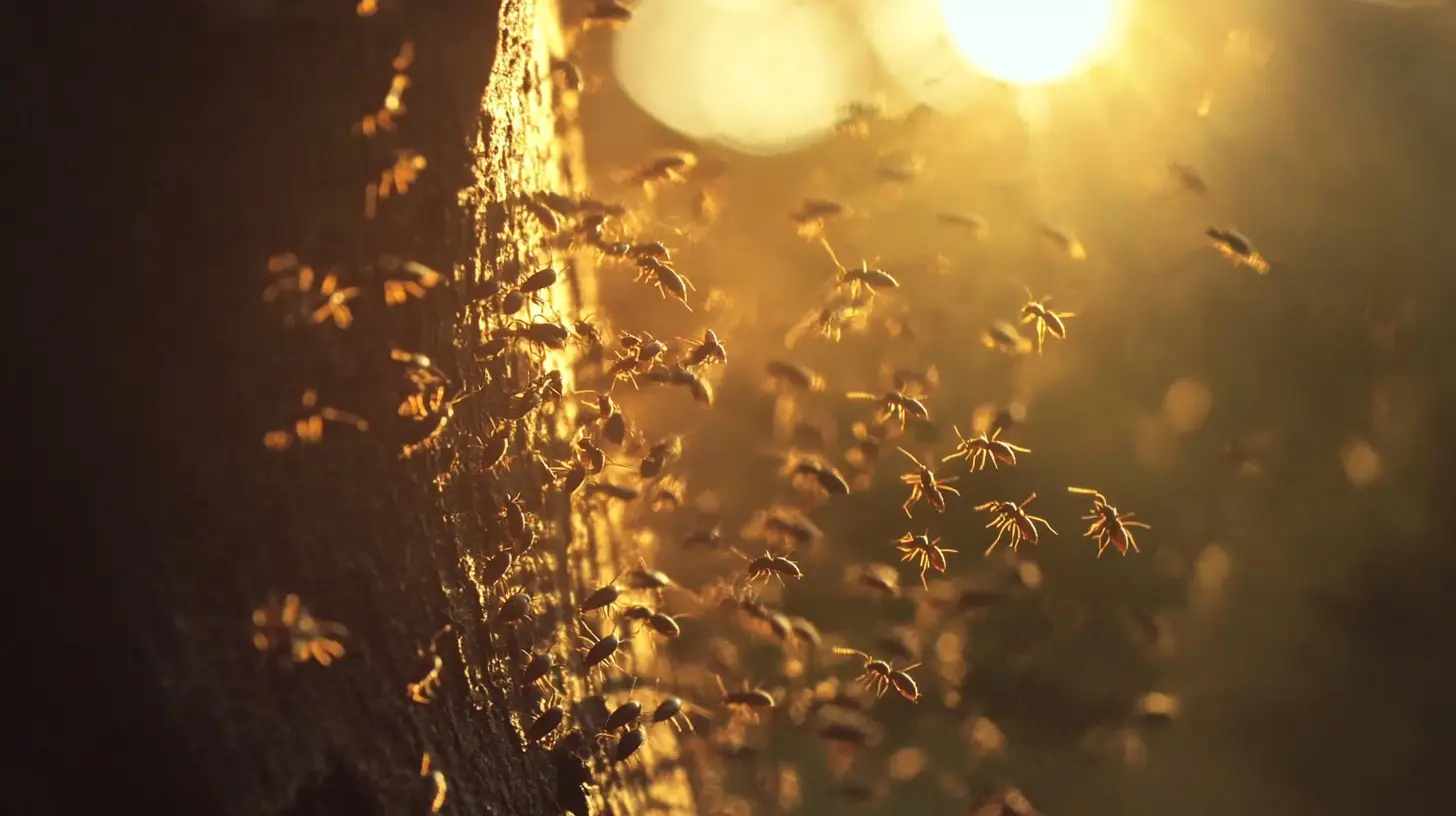
What termite swarmers are
UF/IFAS calls the winged reproductives the most useful form for identification, and notes that after a dispersal flight the alates drop to the ground and shed their wings. For Eastern subterranean termites, UF/IFAS says that after flights inside a building, most alates are found dead near windows or in sinks and bathtubs, often with their wings still attached.
Which nest the swarmers came from varies by group:
- Subterranean termites usually nest in the soil and reach wood through mud tubes.
- Drywood termites live entirely inside the wood they eat and need no soil contact.
- Landscape species live in dead tree branches or similar outdoor wood. UF/IFAS says two Florida drywood species, Incisitermes snyderi and Cryptotermes cavifrons, are primarily found in dead branches of trees, and that C. cavifrons “only rarely infests homes or buildings”. During flight seasons, UF/IFAS adds, their winged reproductives “may make their way into structures, thus giving the illusion that they are infesting the buildings.”
When each species swarms in Florida
UF/IFAS publishes swarm timing by species. These are statewide windows, not city-specific ones.
- Eastern subterranean termite (Reticulitermes flavipes): early January through April. UF/IFAS says these termites disperse on “warm, sunny, and windless early afternoons usually after rain.” A related native species, R. virginicus, flies from early February to late May.
- Formosan subterranean termite: early April to late June, shortly after sunset, with peak swarming in May. UF/IFAS adds that the alates are attracted to lights.
- West Indian drywood termite (Cryptotermes brevis): multiple flights from April to June, though flights are possible any time of the year.
- Cryptotermes cavifrons (a landscape drywood species): evenings all year, with a peak from March through May.
Together, those windows leave no month in which you can rule termite swarmers out. For any given insect on your windowsill, a species identification is the only way to know which one it is.
A 2026 University of Florida study found the invasive Asian subterranean termite established as far north as Hillsborough County on the Gulf Coast and Brevard County on the Atlantic side, and expects it to keep spreading. The summary doesn’t name Manatee or Sarasota County, so it can’t be ruled in or out here by location; a specimen identification settles it.
Flying termites vs. flying ants
This is the common mix-up. UF/IFAS lists the differences between winged ants and termite alates in its carpenter ant publication:
| Feature | Winged ant | Termite swarmer |
|---|---|---|
| Antennae | Elbowed | Beaded (straight) |
| Wings | Front wings larger than hind wings | Front and hind wings the same size |
| Waist | Constricted | Broad |
These are clues for sorting what you’re looking at, not a verdict. A magnifier or a sharp close-up photo helps, and UF/IFAS cautions that termite identification usually needs a microscope or high-resolution camera, even for an experienced identifier. Our flying ants in Bradenton guide covers the ant side, including which ants fly and when.
What a swarm indoors does and doesn’t tell you
Termite swarmers indoors are worth a professional look. They are not a diagnosis.
- It can mean a colony is feeding in or near the building, since UF/IFAS documents swarmers of both subterranean and West Indian drywood termites turning up inside buildings.
- It doesn’t mean the insects came from inside. A landscape species can fly indoors without infesting the building.
- It doesn’t tell you the species, the extent of any damage, or whether the colony is still active.
Details that help an inspector: discarded wings on sills or near light fixtures, where the insects first appeared, the time of day, and whether it had just rained. Other signs of subterranean termites are mud tubes on foundation walls, piers, or slab edges. For drywood termites, look for small piles of six-sided fecal pellets below small kick-out holes. Our drywood vs. subterranean comparison shows both.
What to do when you find swarmers
- Save a sample. UF/IFAS asks for soldiers or winged reproductives, because workers are not reliable for species identification. Put a few in a small sealed container and photograph the wings and body.
- Leave the evidence in place. Don’t tear out damaged wood or knock down mud tubes before an inspection. They show an inspector where to look.
- Get the species identified. UF’s termite ID team accepts samples at no cost. UF/IFAS says “the most important part of termite control is obtaining a correct identification.”
- Book a licensed inspection. UF/IFAS says termites generally require a pest management professional for control. Waves Pest Control’s termite inspection covers the foundation, framing, attic, crawl spaces, perimeter, moisture areas, and garage, with species identification and photo documentation.
What not to do
- Don’t assume the insects are harmless ants, or assume they are termites. Either guess can send you down the wrong path.
- Don’t treat on a guess. Treatment depends on the species: UF/IFAS describes soil termiticides and baits for subterranean termites, while drywood termites live inside the wood and call for localized or other options. A species identification decides which applies.
- Don’t rely on swarm timing alone. The windows above overlap, and a landscape species can fly at times when structural species aren’t.
Waves does not perform tent or whole-structure fumigation; if a drywood infestation goes beyond spot treatment, Waves inspects, explains what it finds, and refers to a fumigation specialist.
For species, signs and swarm seasons in a specific area, see our Venice termite guide, and for a shorter ID walk-through our flying termites guide. UF/IFAS also lists an annual inspection by a trained, licensed termite inspector as part of home maintenance.
Frequently Asked Questions
What are flying termites?
Flying termites are swarmers (alates), the winged reproductives that leave a mature colony to start new ones. Which nest they came from depends on the species, so an identification is how you tell.
When do termites swarm in Southwest Florida?
UF/IFAS puts Eastern subterranean swarms between early January and April, Formosan swarms between early April and late June after sunset, and West Indian drywood flights mainly from April to June, possible any time of year. A landscape drywood species, Cryptotermes cavifrons, flies in the evenings all year.
How do I tell flying termites from flying ants?
According to UF/IFAS, termite swarmers have beaded, straight antennae, wings of equal size, and a broad waist. Winged ants have elbowed antennae, larger front wings, and a constricted waist. Confirming it takes a close look or an inspection.
Do swarmers in my house mean I have termites?
Not by themselves. A swarmer indoors is a clue: it can come from a colony in or near the building, or from a landscape species flying in from outside. A licensed inspection or a sample sent to UF/IFAS tells you which.
Should I spray flying termites?
Hold off until you know what they are. Save a few in a small sealed container, because the species decides the treatment, and UF/IFAS says termites generally require a pest management professional for control.