Jump to a section (8)
- 01Start with standing water
- 02Which mosquitoes you are dealing with
- 03Protect yourself while you work on the yard
- 04Water you cannot dump: larvicides and fish
- 05What county mosquito control does
- 06When mosquito-borne illness is a concern
- 07What professional mosquito control does and does not do
- 08Frequently Asked Questions
The step that does the most, according to the University of Florida, is getting rid of standing water. UF/IFAS Extension calls source reduction “the most important technique that homeowners can employ to reduce mosquitoes” (UF/IFAS, ENY-753/IN1045). No source promises a mosquito-free yard in Southwest Florida, but the steps below, in the order that matters, are what UF/IFAS, the CDC and the Florida Department of Health point to.
This guide covers the mosquitoes you are likely dealing with around Lakewood Ranch, Bradenton, Sarasota and Venice, how to cut their breeding sites, how to protect yourself, what the county mosquito control programs do, and where professional mosquito control fits.
Start with standing water
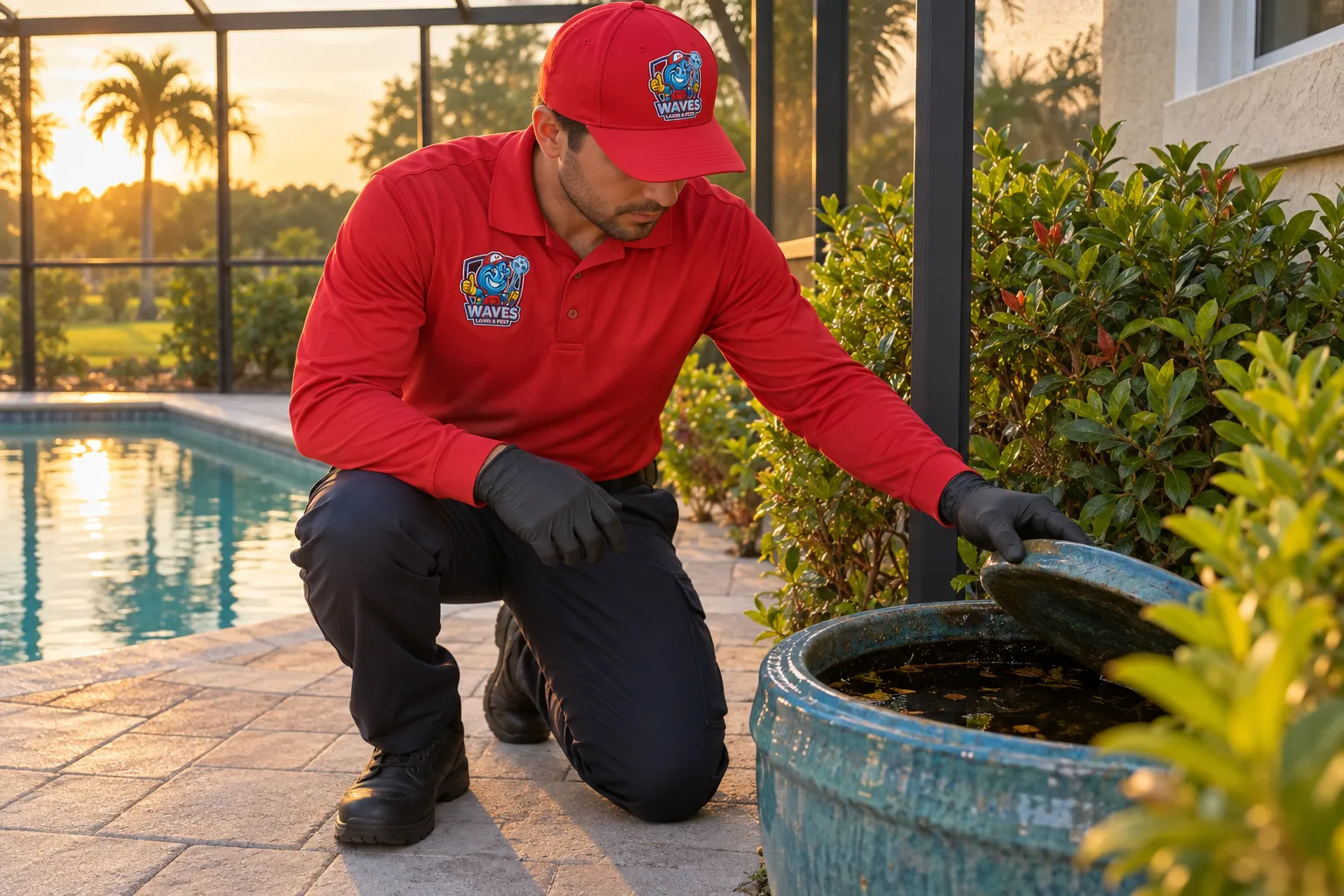
Mosquitoes need water to breed, and in Southwest Florida the water that matters is usually small. UF/IFAS Extension Sarasota County says “it only takes a bottle cap’s worth of water to provide a breeding ground for mosquitoes” (UF/IFAS Sarasota County). The sources give slightly different schedules, so the practical rule is to check often and empty at least weekly:
- Containers in general. The CDC says to empty and scrub, turn over, cover, or throw out items that hold water once a week, naming tires, buckets, toys, pools, birdbaths, flowerpot saucers and trash containers (CDC).
- Birdbaths and pet bowls. The Florida Department of Health says to empty and clean them at least twice a week (Florida DOH).
- Bromeliads. UF/IFAS says that in Florida it is best to flush out containers such as bird baths and bromeliad plants every three to four days during the summer. It also says to empty plant trays and hanging baskets once a week (UF/IFAS IN1045).
- Gutters and eaves. UF/IFAS lists cleaning them as part of source reduction.
- Rain barrels. UF/IFAS says to screen the top or cover it with a lid. Sarasota County’s extension office suggests checking bromeliads, birdbaths and fountains for larvae with a turkey baster (UF/IFAS Sarasota County).
- Pools and tarps. The Florida DOH says to keep swimming pools chlorinated, empty plastic pools when not in use, and use tarps that do not collect water on boats and vehicles.
Check after rain. Sarasota County’s rainy season runs from June 1 to September 30, and the extension office says mosquito numbers rise with it. For a seasonal walk-through, see our Manatee County rainy-season mosquito guide.
Which mosquitoes you are dealing with
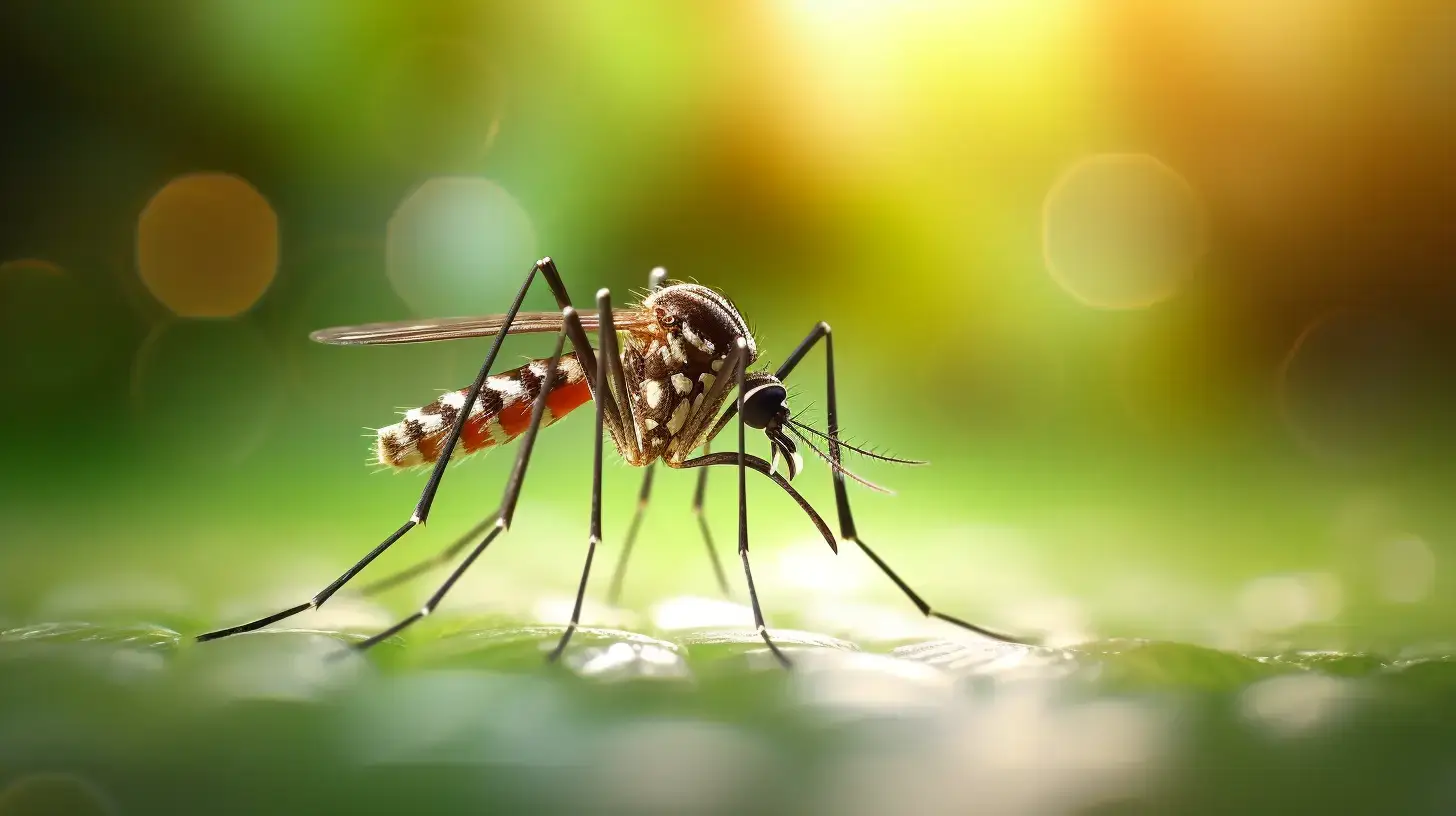
UF/IFAS Extension Sarasota County lists four disease-carrying species in its mosquito FAQ: the yellow fever mosquito (Aedes aegypti), the Asian tiger mosquito (Aedes albopictus), the black salt marsh mosquito (Aedes taeniorhynchus) and the southern house mosquito (Culex quinquefasciatus). They behave differently, and that changes what helps.
| Mosquito | Where it breeds, per UF/IFAS | When it bites |
|---|---|---|
| Asian tiger mosquito | Small containers around homes: tires, birdbaths, flowerpots, pet dishes (IN594) | Mainly during the day, with peaks at dawn and dusk |
| Yellow fever mosquito | Container breeder: unused flowerpots, spare tires, untreated swimming pools, drainage ditches (IN792) | Readily bites during the day, indoors and outdoors |
| Southern house mosquito | Wastewater areas to birdbaths, old tires, or any container that holds water; found in all 67 Florida counties (IN837) | Nighttime; feeds on mammals and birds |
| Black salt marsh mosquito | Eggs laid in moist soil in coastal salt marsh areas; hatches when rain or tides flood them (IN1035) | Mostly at night; females readily bite humans |
Two things follow from this. First, three of the four breed in containers, which is why dumping water around your own house matters. Second, the black salt marsh mosquito does not breed in your flowerpots. UF/IFAS says it has “a long flight range and can be found far inland at times,” and that it emerges in large numbers after rains and flooding. It is also responsible for a large part of mosquito insecticide applications in Florida. Water on your own lot will not fix that one, which is part of why counties run mosquito control programs.
Because some of these bite during the day and others at night, do not limit repellent to dusk. For bites that are not from mosquitoes, see our guide to no-see-ums vs. mosquito bites.
Protect yourself while you work on the yard
Removing breeding sites takes days to show results, so protect your skin in the meantime.
- Use an EPA-registered repellent. The CDC lists DEET, picaridin, IR3535, oil of lemon eucalyptus (OLE), para-menthane-diol (PMD) and 2-undecanone. The CDC says not to use products containing OLE or PMD on children under 3 years old. If you use sunscreen, apply it first and repellent second (CDC). The EPA explains that a registration number means the company gave the agency technical information, including effectiveness against mosquitoes (EPA). Follow the product label. Our mosquito repellent guide goes deeper.
- Cover up. The CDC suggests loose-fitting, long-sleeved shirts and pants, and clothing and gear treated with permethrin. It says not to use permethrin products directly on skin. The Florida DOH recommends netting for infants under 2 months old.
- Keep screens in repair. The CDC says to use screens on windows and doors and repair holes.
- Run a fan. UF/IFAS says mosquitoes are weak fliers and that operating a fan on high will help keep them out of the area, which can help on a lanai or patio.
What does not work
UF/IFAS lists mosquito plants, bug zappers, eating garlic, vitamin B, repellent bracelets, ultrasonic devices and dragonfly mimics among the gimmicks that do not work (UF/IFAS IN1045). For the plant and kitchen-remedy questions, see do mosquito-repelling plants work and does vanilla extract repel mosquitoes.
Water you cannot dump: larvicides and fish
Some water stays: a rain barrel in use, an ornamental pond, a low spot that holds water. UF/IFAS describes larvicides built on a bacterial strain (Bti, Bacillus thuringiensis israelensis) that is toxic to mosquito larvae after they ingest it, and says the active ingredient is very specific to mosquitoes, midges and black flies rather than a broad insecticide. UF/IFAS also says that in ornamental ponds, adding small native fish can help keep larvae down.
Two cautions. UF/IFAS says it is the homeowner’s responsibility to read the label and apply any product only as directed, so follow the label for where it may be used and how. And keep this to small water you own or manage. For roadside ditches, retention ponds, canals and natural water that belongs to someone else, report the problem to your mosquito control program, HOA or community district instead of treating it yourself. Sarasota County’s Mosquito Management Services provides mosquitofish to eligible properties for free, according to UF/IFAS Extension Sarasota County.
What county mosquito control does
Manatee and Sarasota counties both run public mosquito control, and it covers things a single yard cannot.
The Manatee County Mosquito Control District says it prefers larvicides as its front-line approach, usually Bti, applied to roadside ditches and low areas from trucks and to remote wetlands by helicopter (Manatee County Mosquito Control District). It uses adulticide sprays on flying adults when source reduction and larviciding do not produce the reduction needed, at night, when mosquitoes are flying. The district states these sprays “do NOT provide residual effects” and that relief lasts a few days (Manatee County Mosquito Control District). The district takes service requests through its website.
For Sarasota County, start with Mosquito Management Services, the program UF/IFAS Extension identifies as the source of free mosquitofish for eligible properties.
None of that replaces what you do at home. UF/IFAS notes that if your neighbors are not reducing mosquitoes, you are still at risk for bites.
When mosquito-borne illness is a concern
Mosquitoes can carry disease, and the Florida Department of Health tracks it. Its weekly arbovirus surveillance covers West Nile virus, Eastern equine encephalitis, St. Louis encephalitis, dengue, chikungunya, Zika and malaria (Florida DOH). The DOH’s “Drain and Cover” advice is the same as the steps above: drain standing water and cover your skin.
This post cannot tell you whether you are sick. Here is what to do depending on how you feel:
- Talk to a healthcare provider if you have a fever or symptoms after mosquito bites and think you might have a mosquito-borne illness. The CDC says to talk to a healthcare provider if you think you or a loved one might have West Nile virus, and notes there is no licensed vaccine or medicine to prevent or treat it (CDC).
- Seek immediate medical attention for high fever with neck stiffness, muscle weakness, confusion or tremors, which the CDC lists for severe West Nile illness (CDC).
- Get emergency care right away for trouble breathing, chest pain, fainting, or swelling of the face or throat.
What professional mosquito control does and does not do
When dumping water, repellent and screens are not enough, a licensed company can inspect the property and look for breeding sites you missed. UF/IFAS describes one common tool: products labeled for treating vegetation where mosquitoes land, so they pick up the insecticide when they rest on shrubs. UF/IFAS also notes that the adulticides it mentions are broad-spectrum and not specific to mosquitoes, so they should be applied at times and places where other insects are not very active.
What it does not do: it does not stop mosquitoes from flying in from a neighbor’s yard, a retention pond or a marsh, and it does not replace emptying water at home. Anyone who promises no mosquitoes is overpromising. Whoever treats, ask what product is used and where, and have them follow the label. For how this compares across approaches, see mosquito misting system vs. barrier treatment and our overview of professional mosquito treatment.
Waves Pest Control offers mosquito control in Lakewood Ranch, Sarasota and Venice. For a ballpark on pricing, use the pest control calculator.
Frequently Asked Questions
What is the best way to get rid of mosquitoes in my yard?
Remove standing water. UF/IFAS calls source reduction the most important technique homeowners can use, and the CDC says to empty, scrub, cover or discard water-holding items once a week.
Why do I still get bitten after I dump all my water?
Some Florida mosquitoes do not breed in your yard. UF/IFAS says the black salt marsh mosquito has a long flight range and can be found far inland, and that if neighbors are not reducing mosquitoes you are still at risk.
What repellent ingredients does the CDC recommend?
DEET, picaridin, IR3535, oil of lemon eucalyptus, para-menthane-diol (PMD) and 2-undecanone, in EPA-registered products. Do not use OLE or PMD products on children under 3, and follow the label.
Do bug zappers or ultrasonic devices work?
UF/IFAS lists bug zappers and ultrasonic devices among the gimmicks that do not work for mosquitoes, along with mosquito plants and repellent bracelets.
What does the county do about mosquitoes?
The Manatee County Mosquito Control District treats breeding areas with larvicide, mainly Bti, and uses adulticide sprays on flying adults when other methods are not enough. It says those sprays have no residual effect. Sarasota County Mosquito Management Services provides free mosquitofish to eligible properties.
What should I do if I think a mosquito bite made me sick?
Talk to a healthcare provider. Seek immediate medical attention for high fever with neck stiffness, muscle weakness, confusion or tremors, and get emergency care right away for trouble breathing, chest pain, fainting, or swelling of the face or throat.