Jump to a section (11)
- 01Roof rats vs. Norway rats: which one is in Florida?
- 02What a roof rat looks like
- 03Signs of roof rats in and around your home
- 04Why Southwest Florida yards attract roof rats
- 05Exclusion first: seal the house, trim the highway
- 06Trapping basics
- 07Rodenticide cautions
- 08Cleaning up after rats: what the CDC says
- 09When a professional makes sense
- 10More Waves rat guides
- 11Frequently Asked Questions
If you hear scratching in the attic at night or find hollowed-out fruit under a tree, roof rats are a likely suspect. An older UF/IFAS extension publication (SSWEC120, since retired from UF’s site; archived copy) calls the roof rat the worst rodent pest in Florida and the most abundant one, which makes it the rat to expect around a Lakewood Ranch home.
This guide covers what UF/IFAS says about roof rats, how they differ from Norway rats, the signs to look for, why sealing the house comes first, what trapping and rodenticides involve, how to clean up after rats safely, and when it makes sense to call a professional. It is also our hub for rat questions, so it points to our other rodent guides along the way.
Roof rats vs. Norway rats: which one is in Florida?
Florida has two rats that cause most household trouble. UF/IFAS publication SSWEC120 puts it bluntly: “Roof rats are the worst rodent pest in the state of Florida and most abundant. The Norway rat (Rattus norvegicus) that is familiar to most people is rare in Florida” (UF/IFAS). That publication was last revised in 2013 and UF/IFAS has since retired its web page, so read “rare” as a general statewide statement, not a promise that you will never see a Norway rat.
How they tend to differ, based on UF/IFAS and Waves’ rodent facts:
| Roof rat | Norway rat | |
|---|---|---|
| How common in Florida | UF/IFAS (older publication, since retired): worst rodent pest and most abundant | UF/IFAS (older publication, since retired): rare in Florida |
| Where it lives | Climbs. Nests above ground in attics, soffits, debris piles, hollow trees, and old palm frond skirts | Ground dweller. Burrows along foundations, near water, dumpsters, and woodpiles |
| How it gets in | Roofline and soffit gaps, reached by tree limbs, fences, and utility lines | Low entries such as garage gaps, slab penetrations, and door sweeps |
| Droppings | Black, banana-shaped, about 1/4 to 1/2 inch long, pointed at the ends | Larger, with blunt ends |
Mice are a third group with their own signs. Our roof rat, Norway rat, or mouse identification guide walks through droppings, sounds, and entry points, and our guide to getting rid of mice covers the small ones. The roof rat and Norway rat pest identifier pages have quick profiles.
What a roof rat looks like
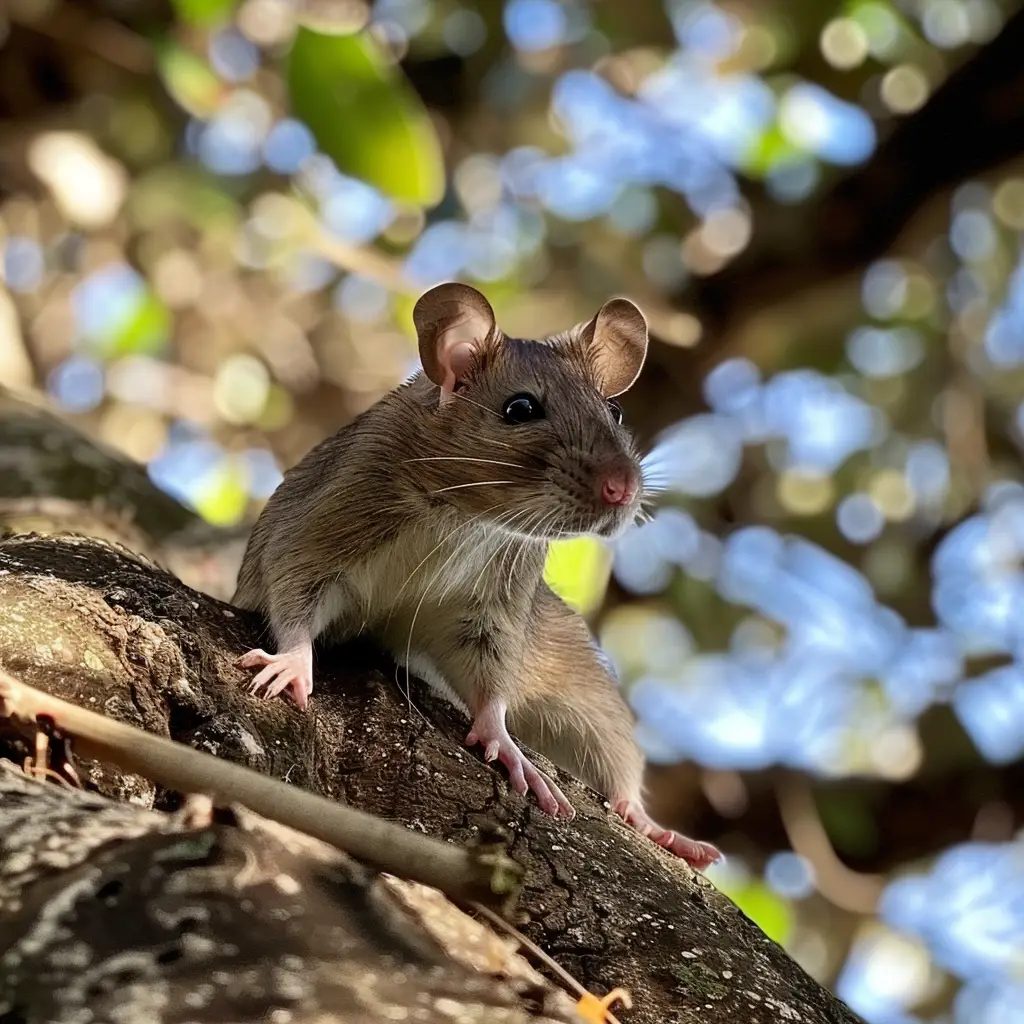
According to the older UF/IFAS publication SSWEC120, an adult roof rat is 12 to 14 inches long including the tail and weighs 5 to 10 ounces. The tail is longer than the head and body combined, hairless, scaly, and black. The body is sleek, with prominent ears and eyes. UF/IFAS describes three color phases in Florida: black back with a slate-gray belly, gray back with a lighter gray belly, and brownish gray above with a white or cream belly.
Roof rats are nocturnal and secretive, so you will usually find signs long before you see the animal. Our roof rat biology guide goes deeper on their life cycle.
Signs of roof rats in and around your home
- Hollowed-out fruit. The older UF/IFAS publication SSWEC120 calls this “the most common evidence of roof rats.” In citrus, the typical damage is a circular hole about the size of a quarter or half dollar with the whole fruit hollowed out. UF/IFAS notes that rats also take whole fruits from some plants, so the damage can be blamed on birds.
- Droppings. Black, banana-shaped, about 1/4 to 1/2 inch long, often along their travel routes.
- Dark smears or rub marks along the routes they travel, such as rafters, pipes, and entry gaps.
- Scratching or scurrying at night in the attic or walls. Waves’ rodent facts describe this as the classic sign of roof rats, because they are nocturnal climbers.
- Gnawed soffit vents, wiring, and pipes. SSWEC120 says rats in buildings chew through wires, which can start fires, and gnaw through plastic and lead water pipes.
Droppings and noise are clues, not a diagnosis. They tell you rodents are around. A species call comes from the whole picture, which is what an inspection is for.
Why Southwest Florida yards attract roof rats
- Fruit. The older UF/IFAS publication SSWEC120 says roof rats are very fond of fruit and feed on most cultivated fruits. They often go unnoticed in a neighborhood until dooryard citrus and other fruit start to ripen. It puts citrus season at September through March.
- Palms and trees. SSWEC120 says roof rats prefer to nest above ground, including in the skirts of old fronds on palm trees, and use tree branches and utility lines to reach food and enter buildings. UF/IFAS landscaping guidance (IN1397) adds that rodents such as rats and squirrels use limbs that touch or overhang the house as a “highway” to get in.
- Other food. Pet food, bird seed in feeders, and garbage all feed them, per SSWEC120.
- Mild winters. SSWEC120 says roof rats breed year-round in Florida, with peak breeding in spring and fall. Waves’ rodent facts note that indoor rodent pressure tends to peak in the cooler months, roughly October through February, as rats move into attics and wall voids, and that mature oak canopy, fruit trees, and dense landscaping sustain roof rats year-round in Southwest Florida.
Exclusion first: seal the house, trim the highway
Waves’ rodent facts say sealing the building is the lasting fix, because baiting or trapping alone leaves the openings for the next rodent. Rats need only about a 1/2-inch gap to get in (mice, about 1/4 inch), so small gaps matter.
What to look at:
- Roofline and soffits. Gable, soffit, and dryer vents, plumbing and A/C line penetrations, and gaps where the roof meets the wall. Rodent-proof materials such as hardware cloth, sealant, and vent covers are the usual choices.
- Tree limbs. UF/IFAS landscaping guidance (IN1397) advises pruning limbs that touch or overhang the house, and notes a roof rat can jump about three feet straight up and more than four feet horizontally, so a short gap between a limb and the roof may not stop one.
- Palms. Prune dead fronds from palms close to buildings, per IN1397. It also recommends pruning seed pods off palms such as pindo and date palms, since the fruit can attract rodents.
- Fallen fruit. Pick it up or use it. IN1397 lists removing rotting or fallen fruit as a basic step.
- Pet food and bird seed. Store food in sealed containers and bring pet food in at night.
Two things the older UF/IFAS publication SSWEC120 says do not work well: ultrasonic or electromagnetic devices (“there is no evidence that these devices will or can drive rodents from their home range,” and ultrasonic devices can cause hearing loss in pets, especially dogs), and relying on a cat or dog. Because roof rats travel above ground, they can often reach attics and fruit trees without touching the ground, and cats are rarely able to handle an adult roof rat in its own territory.
Sealing is physical work at roof height. If you cannot safely reach the roofline, that is a good reason to bring in someone who can.
Trapping basics
The older UF/IFAS publication SSWEC120 says trapping has advantages over poison, because it greatly lowers the risk of a poisoned rat dying inside your home and causing an odor problem. Here is what UF/IFAS says about snap traps for rats:
- Snap traps are useful for rats and mice, and peanut butter and cheese are the recommended baits for rats, per UF/IFAS publication WEC327/UW372.
- Place them along travel paths. UW372 says to place traps near burrows or travel paths, and SSWEC120 notes roof rats like to run along fence stringer boards, wires, and branches.
- Be patient. Roof rats are nervous about new objects, so SSWEC120 says to leave traps in the same spot for at least a week before moving them.
- Outdoors, set traps only from dusk to dawn, per SSWEC120. That avoids catching daytime animals such as protected songbirds.
- Keep traps away from children and pets. UW372 says never to place traps where unsupervised children or pets could trigger them.
Wear gloves and follow the cleanup steps below when you handle a trapped rat or a used trap.
Rodenticide cautions
Rodenticides are the part of rat control where well-meant DIY goes wrong most often. UF/IFAS publication PI284 says “practically any animal, including humans, can suffer severe effects from unintentional exposure to rodenticides.” Key points from UF/IFAS:
- Read the label and follow it, as PI284 says. Everything about how and where a product is used comes from the label, so this guide will not give application directions.
- Secondary poisoning is real. PI284 says cats, dogs, owls, eagles, and hawks that eat a poisoned rodent can be poisoned too, especially from second-generation anticoagulants, which tend to stay in animal tissues longer.
- Outdoor bait goes in tamper-resistant stations. PI284 says to place baits only where children and pets cannot reach them or inside tamper-proof bait stations. The older SSWEC120 publication (archived copy) adds that every rodenticide label in Florida states it is illegal to place bait where children, pets, livestock, or wildlife can reach it unless the bait is in a secured, tamper-resistant station.
- Do not wire bait blocks to tree branches. SSWEC120 says that practice is illegal and has caused thousands of accidental poisonings of dogs and wildlife.
- Remove dead rodents promptly so pets and wildlife do not eat them, per PI284. SSWEC120 adds that a poisoned rat that makes its way into a building can die there and cause an odor problem.
- Retail products are limited. Consumer products are restricted to one pound of bait per package, and four second-generation anticoagulants are not allowed in them, per PI284. Those are available only to professionals.
Waves’ rodent facts follow the same approach: interior control favors trapping over loose bait, and rodenticide is used per the EPA label in tamper-resistant exterior stations to limit the risk to pets and wildlife.
Cleaning up after rats: what the CDC says
This is the step people get wrong, and it has real health consequences. The CDC says not to vacuum or sweep rodent urine, droppings, or nesting material, because that can put tiny droplets containing viruses into the air (CDC). Wet-clean instead:
- Ventilate. Open all doors and windows and leave the area for 30 minutes before you start.
- Put on rubber or plastic gloves.
- Soak the droppings and urine. Spray with an EPA-registered household disinfectant, or a bleach solution mixed fresh (1.5 cups of household bleach in 1 gallon of water, or 1 part bleach to 9 parts water), until very wet. Let it soak for 5 minutes or as the product instructions say.
- Wipe up with paper towels and put them in a covered garbage can.
- Mop or sponge hard surfaces with disinfectant.
- Wash your hands. Wash gloved hands with soap and water or disinfectant before taking the gloves off, then wash bare hands with soap and warm water.
For a dead rat, a nest, or a used trap, the CDC says to wear gloves, spray the rat, nest, and surrounding area with disinfectant, let it soak for 5 minutes, then seal them in a plastic bag with the trap, tie it, put that bag inside a second bag, tie it, and put it in a covered garbage can. Because of fleas, the CDC also suggests insect repellent containing DEET or another EPA-registered repellent on clothing, shoes, and hands. If you are finding fleas or mites after rats, see our rat mites guide.
Heavy contamination is not a DIY job. The CDC lists special precautions for heavy infestations, including coveralls, goggles, and a HEPA-filter respirator that must be properly fitted, and says to contact a professional if rodents have gotten into your heating and cooling ductwork.
Health basics. The CDC’s rat-bite fever page says rat-bite fever can spread through bites, scratches, or contact with a rodent’s saliva or urine, and that anyone bitten or scratched should seek medical care immediately. If you feel sick after being around rodents or cleaning up after them, see a doctor and mention the rodent exposure. Trouble breathing, chest pain, or fainting needs emergency care right away. For what rodents can carry, see our rodent health risks guide and can rats carry rabies.
When a professional makes sense
Call for help if you hear activity in the attic or walls and cannot find the entry point, if you cannot safely reach the roofline, if you have been trapping for a few weeks and the signs keep coming, or if droppings are heavy enough that the cleanup falls under the CDC’s heavy-infestation precautions.
Waves Pest Control provides rodent control for rats and mice: an inspection of the exterior roofline and the attic to identify the species and entry points, exclusion, trapping, and tamper-resistant exterior stations that monitor for re-entry. For roof rats, that includes advice on trimming limbs back off the roof. The standard trapping service includes the setup visit and one follow-up trap check, with more checks scheduled and billed separately if activity continues. Waves handles rats and mice, so for squirrels, raccoons, or other wildlife, contact a licensed wildlife trapper. For cost, use our pest control calculator.
See rodent control in Lakewood Ranch
More Waves rat guides
- Get rid of rats in Bradenton and get rid of rats in Sarasota for local versions of this advice
- Get rid of rat holes in your yard for burrows and ground-level signs
Frequently Asked Questions
Are roof rats or Norway rats more common in Florida?
Roof rats. An older UF/IFAS publication (SSWEC120) calls the roof rat the worst rodent pest in Florida and the most abundant, and describes the Norway rat as rare in Florida. That publication is older (revised 2013) and UF/IFAS has since retired its page, so Norway rats can still turn up, especially near water, dumpsters, and woodpiles.
How do I know if I have roof rats?
Common clues are hollowed-out fruit, black banana-shaped droppings about 1/4 to 1/2 inch long, dark rub marks along travel routes, and scratching in the attic or walls at night. These show rodents are present but do not confirm the species, so an inspection is the way to be sure.
What should I do first to get rid of roof rats?
Seal the entry points and cut off their routes. Rats need only about a 1/2-inch gap, so look at the roofline, soffits, vents, and utility penetrations, and prune limbs that touch or overhang the house. Trapping or baiting without sealing leaves the openings for the next rat.
Can I just use rat poison?
Poison carries real risks. UF/IFAS publication PI284 warns that cats, dogs, owls, and hawks can be poisoned by eating a poisoned rodent, that baits belong only where children and pets cannot reach them or in tamper-proof stations, and that the label controls how a product is used. An older UF/IFAS publication (SSWEC120) also says trapping lowers the risk of a poisoned rat dying inside your home.
How do I clean up rat droppings safely?
Do not sweep or vacuum them, because that can put tiny droplets containing viruses into the air. Open doors and windows and leave for 30 minutes, put on rubber or plastic gloves, spray with an EPA-registered disinfectant or a fresh bleach solution (1.5 cups of household bleach in 1 gallon of water) until very wet, let it soak for 5 minutes (or as the product instructions say), wipe up with paper towels, put them in a covered garbage can, and wash your hands. Trouble breathing, chest pain, or fainting needs emergency care right away.
When should I call a pro?
When you cannot find or safely reach the entry points, when activity continues after a few weeks of trapping, or when contamination is heavy. The CDC says heavy infestations need special precautions and that rodents in heating and cooling ducts call for a professional.