Jump to a section (9)
- 01Which St. Augustine do you have?
- 02Mowing: tall, sharp, and often enough
- 03Watering: less than you think
- 04Fertilizing around the June to September blackout
- 05Chinch bugs: the main insect problem
- 06Diseases: large patch, gray leaf spot, and take-all root rot
- 07A year of St. Augustine care in Southwest Florida
- 08When to call someone
- 09Frequently Asked Questions
St. Augustine grass is the lawn on most Southwest Florida homes, and Floratam is the cultivar you will meet most often around Parrish and the rest of Manatee County. Most of what goes wrong with it comes from the same few things: too much water, nitrogen at the wrong time, mowing too short, and chinch bugs.
This guide covers the cultivars you’re likely to have, how to mow and water it, how to fertilize around Manatee County’s June 1 to September 30 blackout, which problems show up in which season, and a month-by-month calendar. It’s written for Parrish and Manatee County. Much of the care advice applies across Southwest Florida, but fertilizer and watering rules vary by county and city, so check yours.
Which St. Augustine do you have?
UF/IFAS lists several cultivars in its St. Augustinegrass for Florida Lawns guide. The differences that matter most in Southwest Florida are shade tolerance and mowing height:
| Cultivar | Shade tolerance | Mowing height |
|---|---|---|
| Floratam | Fair | 3.5 to 4 inches |
| Palmetto | Very good | 3 to 4 inches |
| CitraBlue | Very good | 2 to 3 inches |
| Seville | Very good | 2 to 2.5 inches |
| Raleigh | Good | 3 to 4 inches |
A few things worth knowing:
- Floratam is the common one here. It was released in 1973 as a chinch bug resistant cultivar, but UF/IFAS notes that within twelve years some chinch bug populations had adapted to it. Its resistance has largely worn off, and UF/IFAS rates its shade tolerance as only fair.
- No cultivar solves chinch bugs. UF/IFAS entomologists say there are no commercially available St. Augustinegrass varieties known to be resistant to the southern chinch bug, so switching cultivars won’t take chinch bugs off the table.
- Shaded yards do better with a different cultivar. Palmetto, CitraBlue, and Seville are all rated “very good” for shade. If a lawn under oaks keeps thinning no matter what you do, the cultivar may be the limit.
- Not every Parrish lawn is St. Augustine. Bahia is common on inland and east-county acreage, including eastern Parrish and Myakka City, and zoysia shows up in some higher-end communities. The mowing height and watering advice below is for St. Augustine.
- Not sure which cultivar you have? Ask whoever installed the sod, or compare the grass to the descriptions in the UF/IFAS guide. The cultivar changes your mowing height, so it’s worth knowing.
Mowing: tall, sharp, and often enough
UF/IFAS recommends 3.5 to 4 inches for standard cultivars like Floratam and 2 to 2.5 inches for the dwarf types such as Seville. Two other rules from the same guide:
- Never remove more than a third of the leaf blade at one mowing. During the growing season that usually means mowing weekly. In cooler months, less often.
- Keep the blade sharp. UF/IFAS suggests sharpening monthly during the growing season.
Taller grass also helps with chinch bugs: UF/IFAS’s chinch bug guidance lists keeping the lawn at 3 to 4 inches among its management steps. For more on common mowing errors, see our guide to St. Augustine mowing mistakes and mowing height by grass type.
Watering: less than you think
Overwatering, not underwatering, is the most common cause of Florida lawn problems. Too much water feeds fungus, dollarweed, and sedge, keeps roots shallow, and can hide chinch bug damage. A lawn on a daily timer is almost always getting too much.
UF/IFAS’s lawn irrigation guidance says to irrigate only when the turf shows drought stress, and that watering an established Florida lawn every day is unnecessary. Its St. Augustinegrass guide describes the signs: leaf blades fold up, wilt, or turn blue-gray, or footprints stay visible after you walk across the lawn.
When you do water:
- Apply about 1/2 to 3/4 inch at a time, which wets roughly the top 8 inches of soil. Find out how long your zones take by setting out a few identical containers, running the sprinklers 15 minutes, and measuring the depth.
- Water in the early-morning window. UF/IFAS says morning watering reduces evaporation and fungal disease, while evening watering keeps leaves wet longer. Under the current watering order that means the hours just after midnight, before 4 a.m.
- Follow the current watering order. Manatee County is under a Modified Phase III water shortage order from the Southwest Florida Water Management District, extended on September 22, 2026, through March 31, 2027 (SWFWMD). Lawns may be watered one day a week, set by the last digit of your address: 0 or 1 Monday, 2 or 3 Tuesday, 4 or 5 Wednesday, 6 or 7 Thursday, 8 or 9 Friday. Hours are 12:01 to 4 a.m. or 8 to 11:59 p.m., and properties under one acre may use only one of those windows (Manatee County). Properties on reclaimed water and some communities with county variances follow different rules, and newly installed lawns have a separate establishment allowance with its own conditions, so check with Manatee County’s water conservation office if any of those apply to you. Rules change with drought conditions, so check Manatee County Utilities before you set your timer.
Our overwatering vs. underwatering guide shows what each one looks like in the yard.
Fertilizing around the June to September blackout
Manatee County’s fertilizer ordinance (No. 11-21) shapes the whole year. According to the county’s Fertilizer Do’s and Don’ts sheet from Manatee County Extension:
- No fertilizer containing nitrogen between June 1 and September 30. Phosphorus is allowed at any time of year only when a soil analysis from a state-certified lab shows a deficiency and that analysis has been filed with the county before you apply.
- From October 1 through May 31, nitrogen fertilizer must be at least 50 percent slow-release.
- Not before a storm. No nitrogen or phosphorus while a severe thunderstorm, flood, tropical storm, or hurricane watch or warning is in effect, or when 2 inches or more of rain is forecast within 24 hours (Ordinance 11-21 summary).
- No more than 4 pounds of nitrogen per 1,000 square feet in a calendar year. UF/IFAS’s guide gives broader ranges by region, but the county cap is the one that applies here.
- Keep fertilizer 10 feet from the top of the bank of any pond, canal, or wetland, and from a seawall. Use a deflector shield on a broadcast spreader, and sweep spills off hard surfaces.
That isn’t the whole ordinance. It also sets per-application limits, which are lower for liquid fertilizer, and restricts fertilizing newly planted turf. Read the county sheet or the fertilizer label for the rate before you apply.
Yellow lawn in the blackout? Manatee County’s soils are mostly Myakka fine sand: sandy, low in organic matter, and quick to lose nutrients. In lawns with higher soil pH, or irrigated from limestone aquifer water, St. Augustine often yellows from iron or manganese deficiency. The fix is the micronutrient that is actually short, not more nitrogen: a nitrogen-free chelated or soluble iron product for iron deficiency, or a manganese product for manganese deficiency. Iron does not correct a manganese shortage. A soil test is useful for pH, which drives these deficiencies, but it can’t tell you which micronutrient is short: UF/IFAS says iron applications should not be based on soil-test iron levels. Have a lawn professional or your county Extension office diagnose the yellowing before you buy anything. Our fertilizer blackout guide for Manatee County goes through the summer rules in more detail.
Chinch bugs: the main insect problem
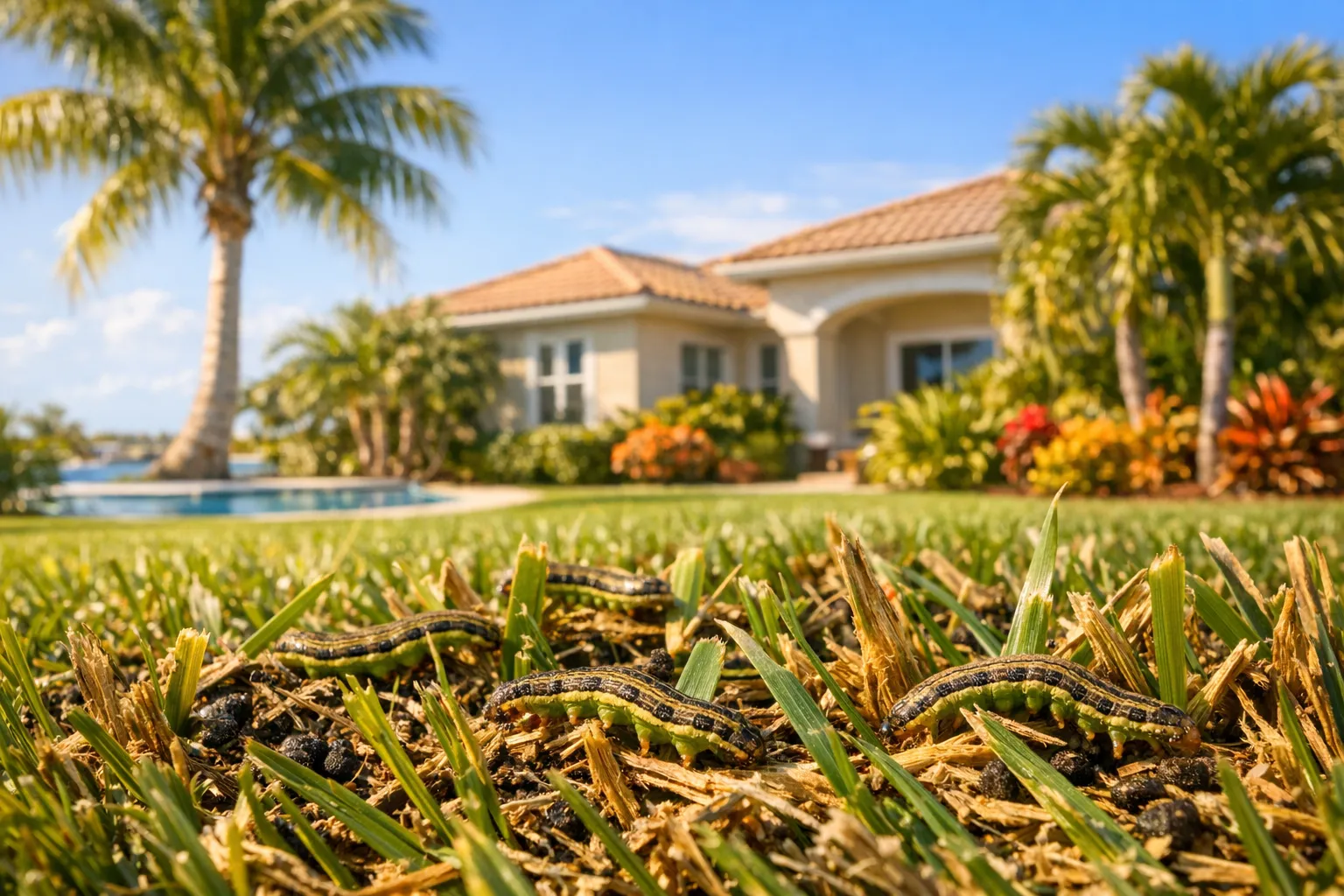
UF/IFAS Gardening Solutions calls St. Augustinegrass the most vulnerable turf and the chinch bug the most damaging insect pest of turfgrass in the state. In Manatee County they’re active year-round, and damage shows up first in full-sun, water-stressed areas along sidewalks, driveways, and patios.
What it looks like. UF/IFAS describes circular discolored patches where the grass goes from healthy green to brown-yellow and finally dies. Patches that don’t green up after watering are a clue, not a diagnosis: UF/IFAS notes that drought, root rot, nematodes and other problems can look similar, and turf that has already died from drought won’t recover either. The way to know is to find the insects.
How to check. Use the UF/IFAS flotation test:
- Cut both ends off a coffee can and push it about 3 inches into the soil at the edge of a damaged patch.
- Fill the can with water and keep it full for five minutes.
- Chinch bugs, tiny black-and-white insects, float to the surface.
- Repeat at least four times around the edge of the patch, since they cluster unevenly.
What to do. Chinch bug treatment is an insecticide applied to the affected area, with product rotation because some populations have become resistant. Excess nitrogen and poor irrigation distribution make lawns more susceptible, so the cultural habits above are part of the fix. Our chinch bug guide for Bradenton covers the check and treatment decision in more detail.
Diseases: large patch, gray leaf spot, and take-all root rot
All three diseases are driven by moisture, and UF/IFAS lists them together in its St. Augustinegrass guide. Each peaks in a different season.
Large patch (fall through spring)
Caused by the fungus Rhizoctonia solani, large patch is most often seen from November through May, when temperatures drop below 80 degrees. Look for round, discolored patches that expand over time, sometimes with an orange border. The leaves pull easily off the stem, and the base may be dark and smell of rot.
Excess irrigation, rain, high humidity, and too much nitrogen all contribute. UF/IFAS advises watering only when necessary, always in the morning, and applying only slow-release nitrogen, sparingly. It lists the end of October as fungicide timing for South Florida. See our large patch guide.
Gray leaf spot (summer rainy season)
Gray leaf spot develops from May through September, in warm, rainy weather between 80 and 90 degrees. It hits new growth first, causing oblong spots and a thin, unthrifty lawn. UF/IFAS notes that no St. Augustinegrass cultivar on the market is immune, and that heavy nitrogen feeding produces lush growth that is especially susceptible. Avoid late-day irrigation. UF/IFAS lists Floratam as susceptible in its St. Augustinegrass guide. More in our gray leaf spot guide.
Take-all root rot (summer and early fall)
Take-all affects the roots, not the leaves. UF/IFAS says it appears in the summer and early fall rainy months as irregular yellow or light green patches, and because the roots can’t take up water or nutrients, it looks like drought or a nutrient shortage. By the time the leaves show it, the fungus has usually been on the roots for at least two to three weeks. The cultural basics matter most: mow often enough to take only a third of the leaf at a time and use slow-release nitrogen.
Large patch and gray leaf spot can be managed with a labeled fungicide, but UF/IFAS puts cultural practices first. Take-all is harder: UF/IFAS says it is very difficult to control once the leaves show symptoms, and fungicides for it work best as a preventive, before symptoms appear. A lawn that stays wet will keep getting sick.
A year of St. Augustine care in Southwest Florida
| When | What to do |
|---|---|
| February to early March | Pre-emergent weed control goes down before daytime highs hold at 65 to 70 degrees for 4 to 5 days in a row. UF/IFAS puts the spring window around early to mid-February for this part of the state. Crabgrass is the main target. |
| April and May | Fertilize established lawns with slow-release nitrogen (at least 50 percent) before the blackout starts, but not ahead of a storm watch or heavy-rain forecast; newly laid sod follows the county’s new-turf rules. Mow weekly. Check full-sun edges for chinch bugs. Large patch can linger into May. |
| June 1 to September 30 | No nitrogen. Phosphorus only with a filed, state-certified soil test showing a deficiency. If the lawn yellows, have it diagnosed and correct the iron or manganese shortage it actually has. Watch for chinch bugs, gray leaf spot (through September), and take-all. Don’t irrigate on a daily timer, even with the rain. |
| October and November | Nitrogen is allowed again on October 1 (at least 50 percent slow-release). Tropical sod webworm adults are higher from September through November. Large patch season begins as nights cool. A fall pre-emergent goes down when night temperatures drop to 55 to 60 degrees, typically late October into early November. |
| December to January | Growth slows. Mow less often, keep the height up, and water only when the lawn shows wilt. Large patch stays active, so avoid overwatering and extra nitrogen. |
When to call someone
Waves Pest Control’s lawn care in Parrish covers fertility, weed, insect, and disease control, and diagnosing what’s wrong with a lawn. It doesn’t cover mowing, trimming, or irrigation repair, which are referred out. If a patch isn’t responding to water and the flotation test is inconclusive, a diagnosis is a better first step than guessing with products. For pricing, use the pricing calculator.
Frequently Asked Questions
How tall should I mow St. Augustine grass?
UF/IFAS recommends 3.5 to 4 inches for standard cultivars such as Floratam and 2 to 2.5 inches for dwarf cultivars like Seville. Never cut more than one third of the blade at a time.
How often should I water St. Augustine grass in Florida?
Only when it shows wilt: blades folding or turning blue-gray, or footprints staying visible. Then apply about 1/2 to 3/4 inch, in the early-morning window on your assigned watering day. Daily watering isn’t needed for an established lawn.
Can I fertilize my St. Augustine lawn in the summer in Manatee County?
Not with nitrogen. The county’s nitrogen blackout runs June 1 through September 30, and phosphorus is allowed at any time of year only when a state-certified soil analysis shows a deficiency and has been filed with the county first. The rest of the year, nitrogen fertilizer must be at least 50 percent slow-release, and total nitrogen is capped at 4 pounds per 1,000 square feet per year.
What is the best St. Augustine grass for shade?
UF/IFAS rates Palmetto, CitraBlue, Seville, and Classic as “very good” for shade tolerance, while Floratam is only fair. If you’re choosing sod or replacing a thin shaded area, that rating is the thing to compare.
Is my lawn dying from chinch bugs or drought?
Watering is a first clue: stressed grass that greens up was probably dry, while patches that keep spreading need a closer look. To confirm chinch bugs, do the coffee-can flotation test at the edge of a patch. If no insects float up in five minutes, try again at several spots, and consider other causes such as take-all root rot.
Why is my St. Augustine yellow even though I fertilize?
Several causes can look alike: iron deficiency in sandy, higher-pH soil, chinch bugs, or a root problem like take-all root rot. Extra nitrogen won’t fix iron deficiency and can make fungal disease worse. A professional diagnosis, including a close look at the patch edge, sorts out which one it is.