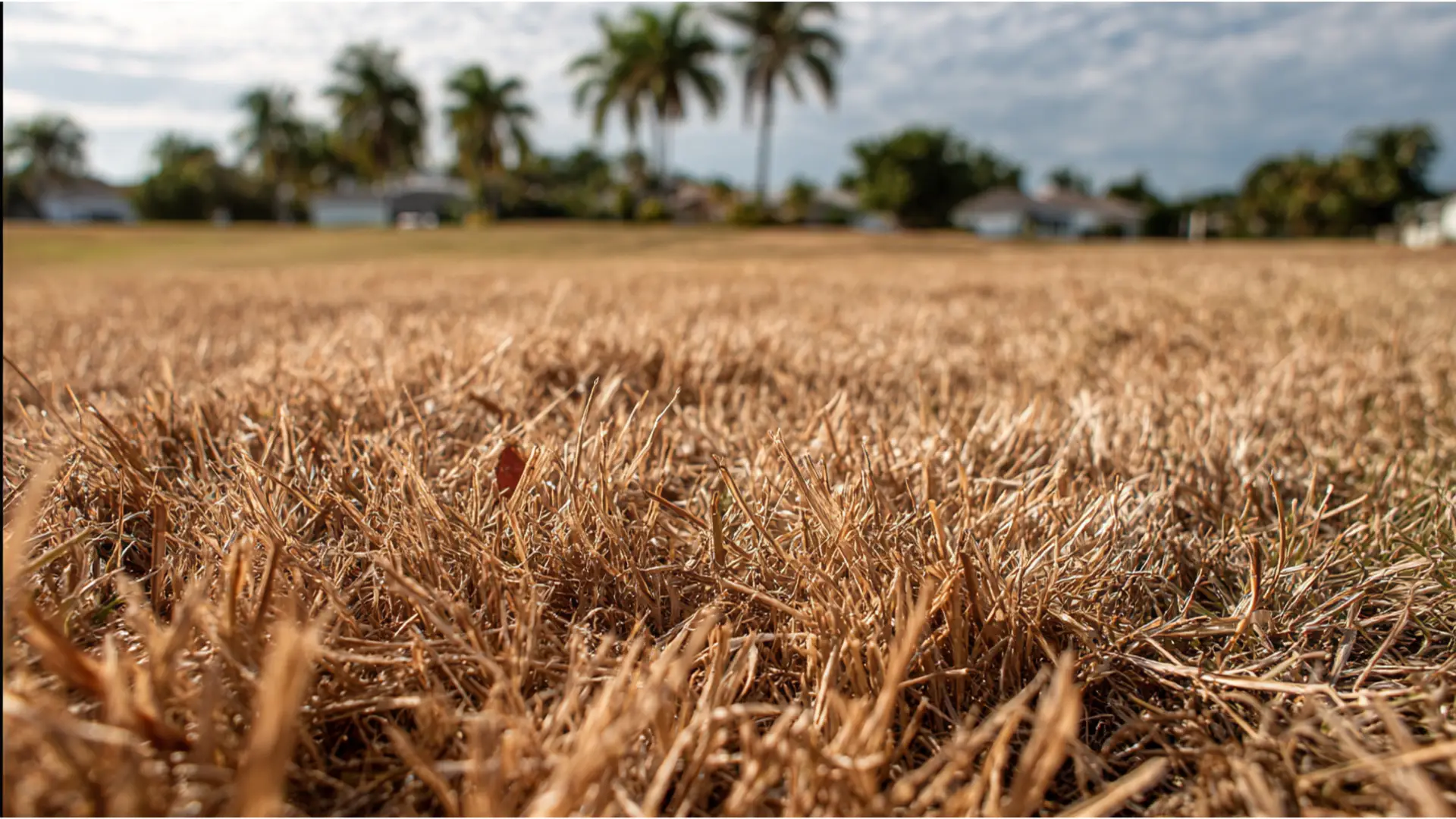
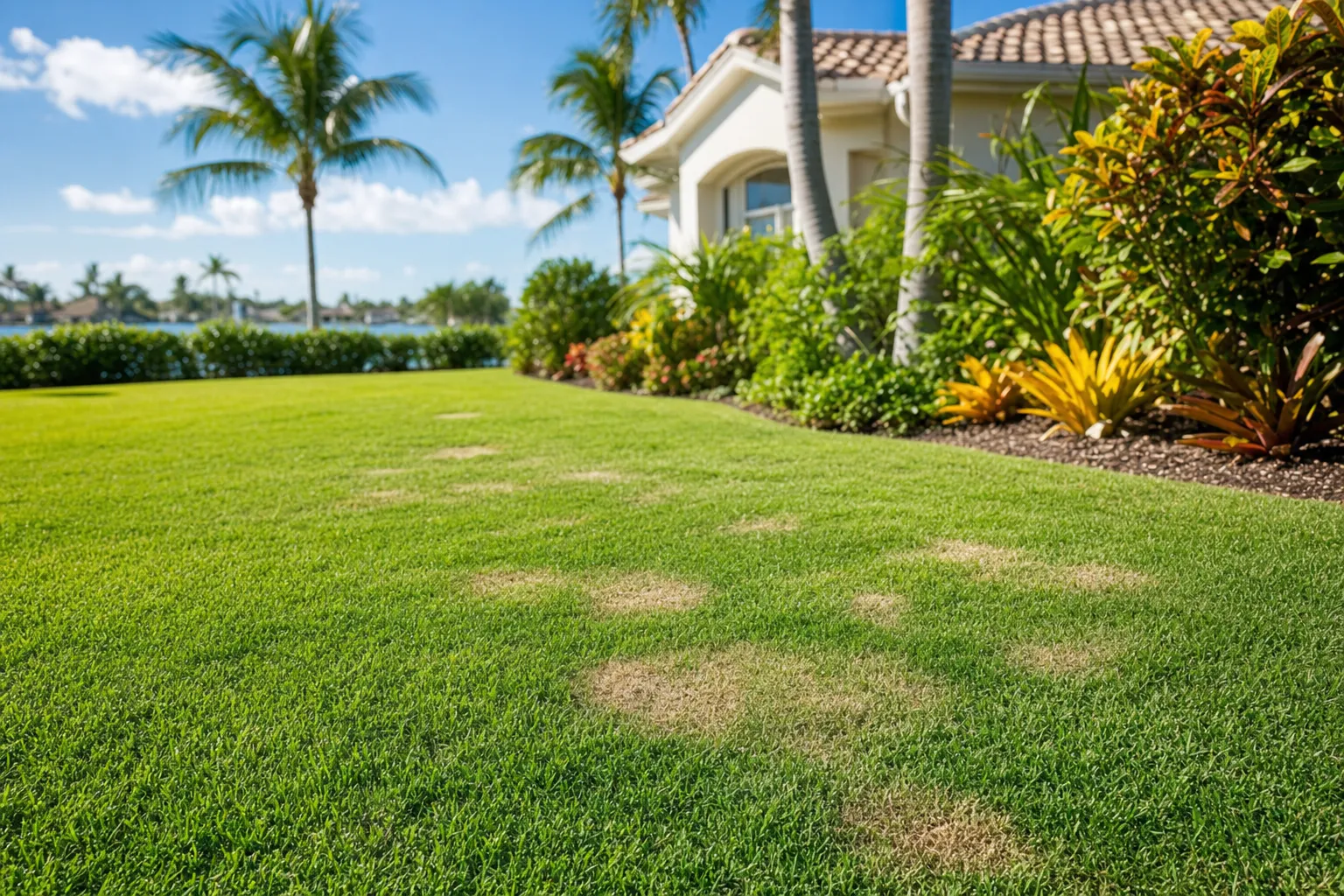
You walked outside this morning, coffee in hand, and noticed it. Little round dead spots all over your Venice lawn. About the size of a silver dollar. Some bleached-out, some tan, some crusty around the edges.
Your first thought? “I need to fertilize.”
Your second thought? “I’ll water it more.”
Both of those instincts are going to make this worse. Significantly worse. Let’s talk about why.
What You’re Actually Looking At
Dollar spot fungus in Venice FL is exactly what it sounds like — a fungal disease that creates small, circular dead patches roughly the size of an old silver dollar (2-6 inches across). On St. Augustine, the spots usually look bleached or straw-colored. On Bermuda, they tend to be more sunken and tan.
If you look closely in the early morning when the dew is still on the grass, you might see what looks like white cobwebs across the blades. That’s mycelium — the fungus itself, doing its thing right in front of you.
The pathogen behind it is a fungus in the Clarireedia genus (it all used to sit under one name, Sclerotinia homoeocarpa, until taxonomists split it up). On warm-season Southwest Florida turf like St. Augustine and Bermuda, the one you are dealing with is almost always Clarireedia monteithiana — its cool-season cousin C. jacksonii is a northern-lawn problem. And it loves Venice. Loves it.
Why Venice Lawns Are a Dollar Spot Buffet
Three things make dollar spot thrive: warm humid air, heavy morning dew, and stressed-out turf. Congratulations — that’s basically every Venice lawn from May through October.
Our coastal humidity stays above 75% most mornings. The afternoon storms June through September leave your blades wet for hours. And our sandy soil drains so fast that the moment you skip a watering or two, your grass goes into stress mode and the fungus walks right in.
Add in the nitrogen blackout — June 1 through September 30 in Sarasota County, when you legally can’t apply nitrogen fertilizer — and you’ve got the perfect setup. Your grass is low on nitrogen (which, ironically, makes dollar spot worse), the humidity is brutal, and you can’t just toss down a bag of 16-4-8 to fix it.
Why Fertilizer Is the Wrong Move (Mostly)
Here’s where most Venice homeowners get it wrong. You see dead spots, you assume the grass is hungry, and you head to the big-box store for a bag of fertilizer.
Two problems.
One: during the nitrogen blackout, you’re breaking the law in Sarasota County if you apply nitrogen between June 1 and September 30. That fine isn’t cheap.
Two: even when you can fertilize, dumping high-nitrogen quick-release fertilizer on a fungus-infected lawn is like throwing gasoline on a campfire. Some fungi love nitrogen surges. Dollar spot is weird — it actually likes low nitrogen lawns, but rapid nitrogen swings still stress the grass and spread the disease through the lush new growth.
What your lawn actually needs is steady, balanced nutrition — not a panic feeding.
Pro tip: If you’re inside the nitrogen blackout window, you can still apply potassium and iron. A potassium boost actually helps your grass resist fungal disease. Look for a 0-0-22 or similar product with no nitrogen and no phosphorus.
The Watering Mistake That’s Feeding the Fungus
You’re probably watering wrong. Not your fault — most Venice homeowners are.
Dollar spot fungus needs leaf moisture to spread. Every time you water in the evening, or run your sprinklers at 9 PM because “it’s cooler,” you’re giving the fungus 12 straight hours of wet grass to colonize.
Water early. Like, 4 AM to 8 AM early. The blades dry off by mid-morning and the fungus loses its window. Also — water deeply and infrequently. Half an inch twice a week beats 15 minutes every day. Sandy Venice soil drains fast, so shallow daily watering keeps the surface wet (fungus heaven) without ever soaking the root zone.
If your irrigation system runs every single day, that’s probably half your problem right there.
What Actually Kills Dollar Spot
Real treatment for dollar spot fungus in Venice FL takes a fungicide — but not just any fungicide. The active ingredients that actually work:
- Propiconazole — systemic, gets into the plant, 14-28 day control
- Azoxystrobin — broad-spectrum, great for early-stage outbreaks
- Myclobutanil — solid curative option for established infections
- Thiophanate-methyl — older but still effective on dollar spot specifically
You’ll typically need two applications, 14 days apart, to actually break the disease cycle. One spray and done? You’ll see it come right back in three weeks.
Cultural fixes matter too: mow at the correct height (St. Augustine should be at 3.5-4 inches — not lower), keep your blades sharp (torn grass tips = open wounds = fungus entry), and bag your clippings while the disease is active so you’re not spreading spores around the yard.
Pro tip: Rinse your mower deck off after every mow during a dollar spot outbreak. Sounds extra. Isn’t. Spores ride on grass clippings and you’ll re-infect spots you just treated.
When to Stop DIY-ing
If you’ve got a few small spots, you’ve got time to fix your watering, mow correctly, and maybe hit it with a store-bought fungicide.
If you’ve got dozens of spots merging into bigger dead patches, or you’ve already tried fertilizer and it’s spreading — stop. Every wrong move is making the recovery longer and more expensive. Dollar spot can turn a great-looking Venice lawn into a moonscape in about three weeks if you keep doing the wrong things.
At that point it’s worth bringing in a professional lawn treatment program in Venice before you waste more money on the wrong product.
Frequently Asked Questions
How long does it take to recover from dollar spot fungus?
With proper treatment, you’ll see new growth filling in the spots within 3-6 weeks. The fungicide stops the spread in about 7-10 days, but the grass itself needs time to grow back into those bare patches — especially during the nitrogen blackout when growth is already slower.
Can dollar spot kill my entire Venice lawn?
It usually won’t kill the lawn outright, but it can damage 30-50% of your turf if left untreated through a full Venice summer. The bigger risk is that the weakened, thinned grass gets invaded by weeds — doveweed and crabgrass especially — and now you’ve got two problems instead of one.
Will dollar spot come back next year?
Probably, yes — the spores survive in your thatch layer and soil. But if you correct your watering schedule, keep your mowing height right, and apply a preventive fungicide in late spring before humidity spikes, you can dramatically reduce next year’s outbreak.
Dollar spot is one of those Venice lawn problems where the “obvious” fixes are exactly what makes it worse. If your lawn is dotted with silver-dollar-sized dead spots and you’re not sure what to do next, the team at Waves does free lawn evaluations — we’ll tell you what’s actually going on out there before you waste another weekend guessing.