Jump to a section (14)
- 01Key Takeaways
- 02What “quarterly” actually means
- 03The protocol you’re paying for: Exterior General Pest Perimeter
- 04"Do I need to be home?”
- 05“Is it safe?” — kids, pets, and re-entry
- 06Your post-service report
- 07Where every report lives: your customer portal
- 08Is quarterly pest control worth it? Quarterly program vs. one-time spray
- 09How you get your quote: request to first visit
- 10Pricing and protection levels
- 11The Waves Guarantee
- 12Complete your home’s protection in Lakewood Ranch
- 13Ready to get started in Lakewood Ranch?
- 14Frequently Asked Questions
“Quarterly pest control” gets sold as a vague promise — we’ll come out four times a year and spray. That tells you the frequency and nothing else. It doesn’t tell you what gets treated, why it works, or whether you’re getting anything more than someone walking the yard with a wand for ten minutes.
So here’s the honest version for your Lakewood Ranch home: quarterly pest control with Waves means the same named, documented protocol, performed four times a year, with every step logged to a report that lands on your phone the same day. Below is exactly what that protocol is, why it’s built the way it is, and how to decide whether quarterly is the right cadence for your house.
If you want the full moment-by-moment walkthrough of a single visit — from the estimate through GPS tracking to the report — we wrote that up separately in what to expect during a Waves pest control visit. This post is about the quarterly program itself: what you pay for, and whether it’s worth it.
Key Takeaways
- Quarterly = the same protocol, 4 times a year. Every visit runs our Exterior General Pest Perimeter protocol — a fixed, named sequence, not a freestyle spray.
- Two modes of action, on purpose. We pair a repellent barrier with non-repellent products so trailing pests carry treatment back to the colony instead of just being pushed around.
- The lanai, screen cage, and front door are included. Web and nest sweep-downs are a required step of the visit, not an add-on.
- You watch your tech arrive on live GPS tracking, and you get a same-day post-service report with a treatment map and your Pest Pressure Index — not a door hanger.
- A licensed pro does the work. Waves operates under FDACS License JB351547.
- The Waves Guarantee: if pests show up between scheduled visits, we come back and re-treat at no extra charge.
What “quarterly” actually means
Quarterly means a scheduled visit every three months — four times a year. That cadence isn’t arbitrary. In Southwest Florida there’s no real winter to reset the bug clock, so the protective barrier you put down doesn’t get a seasonal break — it slowly breaks down under sun, rain, and irrigation while pest pressure keeps rebuilding. A three-month interval is the sweet spot that keeps the exterior barrier intact between visits for most homes, instead of letting it lapse and starting from scratch.
Seasonal pressure
Southwest Florida pest pressure through the year
- Spring Mar–MayBuilding
Warming weather wakes colonies up — activity climbs week over week.
- Summer / rainy season Jun–AugPeak
Heat + humidity + standing water = the year’s heaviest pressure.
- Hurricane season Sep–OctSurge
Storms and flooding push pests indoors looking for dry shelter.
- Fall NovActive
Cooler nights slow things down, but activity stays well above zero.
- Winter Dec–FebLower (not zero)
Our mild winters keep many pests going year-round indoors.
Summer / rainy season & Hurricane season run hottest. In Southwest Florida, pest pressure eases in winter but never fully stops — that’s why year-round protection beats a seasonal patch.
For some homes — ones backing up to a retention pond, heavy palms, or with a history of German roaches or fleas — we’ll recommend a tighter cadence (bi-monthly or monthly). But for the typical Lakewood Ranch home, quarterly keeps the pressure down without over-treating.
The protocol you’re paying for: Exterior General Pest Perimeter
Here’s the part most companies won’t put in writing. Every routine quarterly visit at Waves runs a single, named protocol — Exterior General Pest Perimeter — and it’s the same fixed sequence of products, areas, and actions every time. Your tech doesn’t improvise the core service; they perform a defined protocol and attest to it.
That matters for one simple reason: consistency you can verify. Once a protocol is activated in our system, its products, treatment areas, and steps are locked — they literally can’t be quietly edited visit to visit. If we change the protocol, it becomes a new, versioned protocol; the old one is retired. So “the same service every quarter” isn’t a slogan, it’s how the system is built.
Two modes of action — and why that’s the whole game
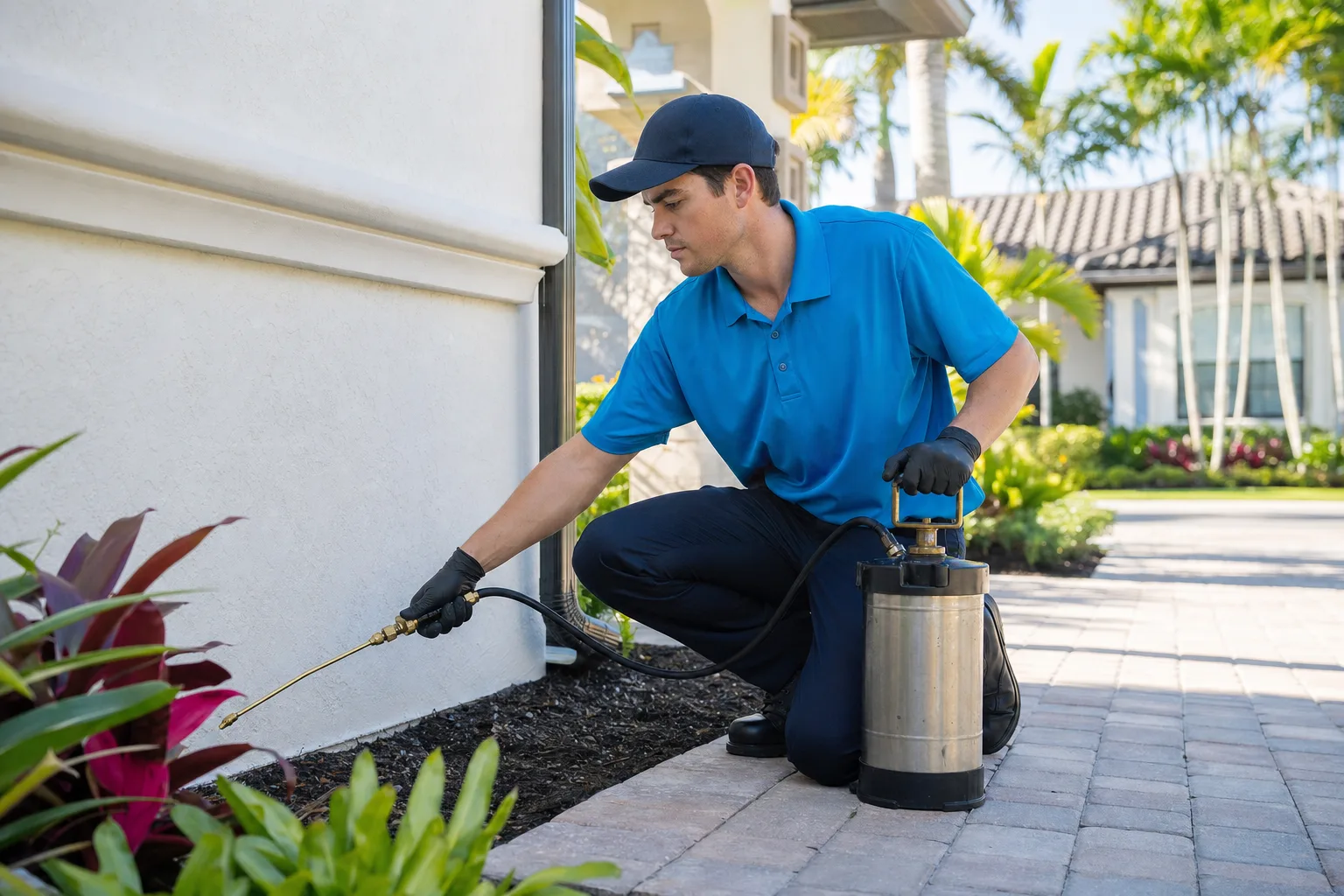
A typical visit starts with a full sweep-down of pest pheromone trails, then treatment using both non-repellent and repellent solutions — each mode of action applied across the home’s foundation, entry points, and cracks and crevices. That pairing is the part cheap “spray-and-go” services get wrong.
- Repellent product (a synthetic pyrethroid barrier) creates a perimeter band pests don’t want to cross. Great for a defended exterior line.
- Non-repellent products are the opposite by design: pests can’t detect them, so they walk through, pick up the active ingredient, and carry it back along their trails to the colony — a transfer effect that knocks down the source, not just the scouts you can see.
If you only spray a repellent, you can actually split an ant trail and scatter the problem. Pairing the two modes — repellent perimeter plus non-repellent transfer — is why a properly built protocol holds up between quarterly visits. The protocol uses three products to do this: a repellent perimeter band (Demand CS), a non-repellent product (Alpine WSG), and a non-repellent granular broadcast (Advion WDG Granular) for the foundation, beds, and entry zones. Every product is applied strictly to its EPA label by a licensed technician.
The areas we treat
The protocol defines the zones every quarterly visit covers — the perimeter (the foundation band around the home), the garage, and entry points (doors, windows, vents, and the cracks and crevices pests use to get in). On top of the chemical barrier, planting beds and shrubs get applications, and the granular work covers turf edges and mulch beds where ants and other ground pests stage.
Your home, zone by zone
Where we inspect & treat
A typical Southwest Florida home — the numbered zones a local tech walks on every visit.
- Foundation perimeter Exterior barrier band — the first line where pests cross in from the yard.
- Entry points (doors/windows) Thresholds and frames where ants and roaches slip indoors.
- Eaves & soffits Up under the roofline where wasps and spiders like to nest.
- Weep holes Block-wall gaps that let pests behind the brick veneer.
- Garage corners Dark, cluttered edges spiders and roaches favor.
- Lanai & screen cage The classic SWFL hot spot for spiders, midges and palmetto bugs.
- Mulch beds & turf edges Damp landscaping that harbors ants, fleas and chinch bugs.
- Interior baseboards Where indoor crawlers travel along the wall line.
- Kitchen & bath plumbing gaps Pipe penetrations roaches and ants use to move room to room.
- Attic Top of the home — checked for rodent runs and nesting.
The web and nest sweep-down (yes, including the lanai and front door)
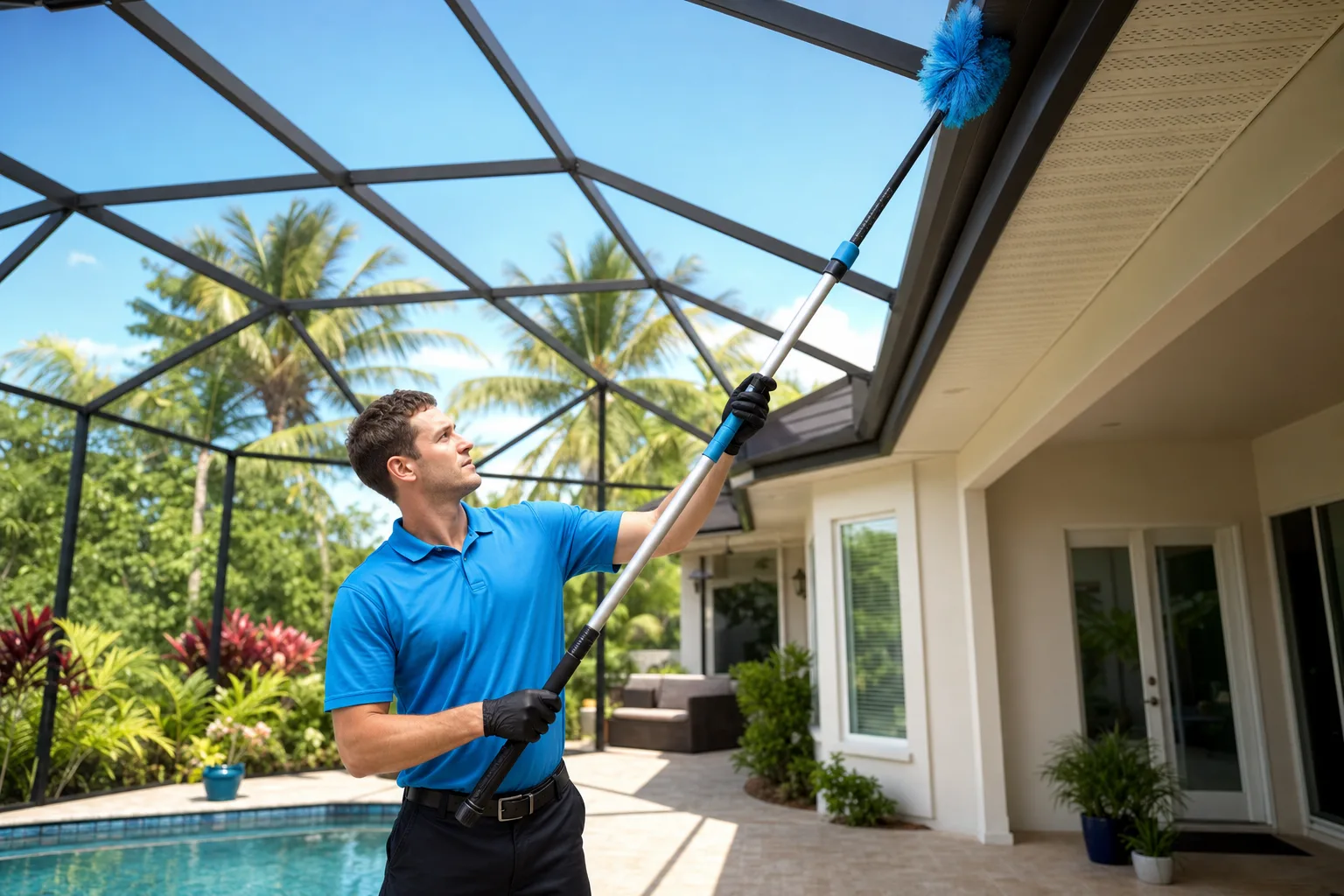
This is a required step of the visit, not an upsell. Your tech does a Webster sweep — knocking down spider webs and wasp/mud-dauber nests from the eaves, windows, and doors — and that explicitly includes the lanai and screen-cage frames and the front-door area. In a Florida home, the lanai cage and front entry are exactly where webs and nests rebuild fastest, so sweeping them every quarter is part of the standard service.
What the tech watches for — and the optional steps
Beyond the fixed treatment steps, your tech inspects for conducive conditions and has two standing optional actions in the protocol: placing glue-board monitors in the garage or utility areas to catch what’s moving, and escalating any moisture, exclusion, or sanitation issues into your notes so you’re not blindsided by a bigger problem later.
On every inspection
What your tech is looking for
- Droppings Size and spread tell us the pest and how many.
- Mud tubes Pencil-thin trails signal subterranean termites.
- Egg casings Roach ootheca mean an active breeding spot.
- Grease/rub marks Dark smudges along runs from rodent traffic.
- Ant trails Steady lines lead us back to the colony.
- Gnaw marks Fresh chewing on wood, wire, or packaging.
- Moisture spots Damp areas that draw pests and hide nests.
- Entry gaps Cracks and openings we seal at the source.
One-tap, documented completion
When the work is done, your tech completes the visit with a single attestation — “I performed the Exterior General Pest Perimeter protocol on this visit: Demand CS, Alpine WSG, and Advion WDG Granular applied to Perimeter, Garage, and Entry points.” That statement, the products, the areas, and the steps all flow straight into your report. There’s no gap between “what was supposed to happen” and “what’s on the paperwork."
"Do I need to be home?”
For a standard quarterly exterior visit — no, as long as we have access to the gates, the lanai, and the garage, and pets are secured. The core protocol is exterior. Interior treatment is targeted and on-request (kitchens, baths, problem rooms get crack-and-crevice and baiting, not blanket spraying), so plenty of recurring customers skip the interior most quarters because the exterior barrier is holding. If you do want interior work, you’ll want someone home to let the tech in.
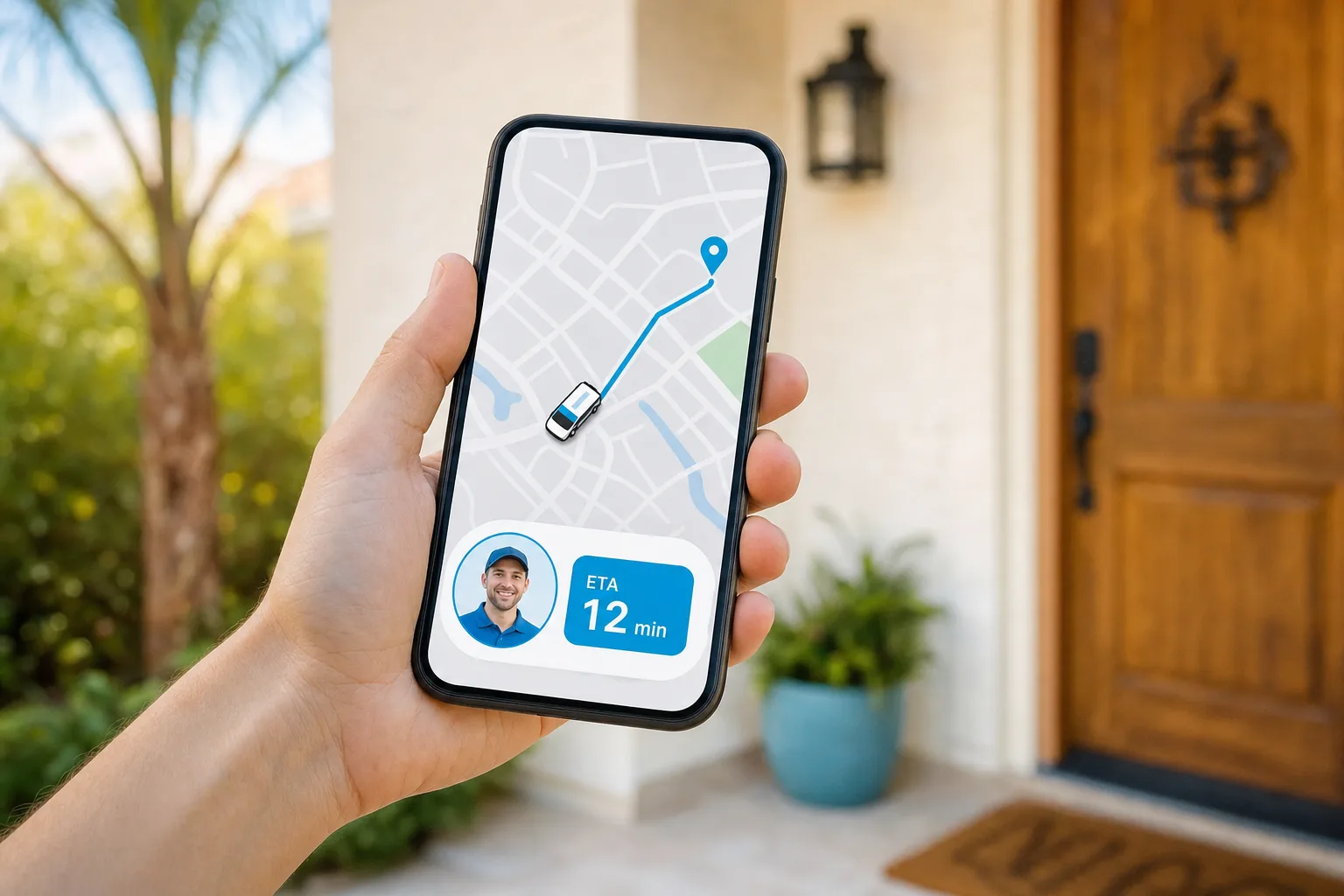
Either way, you’re never guessing about timing. On service day you tap your live tracking link and watch your actual GPS-tracked truck approach, with your named technician’s photo and a real-time ETA — no four-hour window.
“Is it safe?” — kids, pets, and re-entry
The most common question we get. Every product is applied strictly to its label by a technician licensed under FDACS License JB351547. Label-compliant application is the safety standard, not a vibe. Your tech will give you practical re-entry guidance for treated areas — for the repellent perimeter band, for example, that typically means staying off it until it’s dry — plus any pet or lanai notes specific to your visit. The goal is straightforward, professional protection handled by someone who does this all day, every day.
Your post-service report
This is what separates a real quarterly program from “someone sprayed something.” After every visit, a complete digital report lands on your phone the same day — by text and/or email — and it’s built live in the field as the tech works, not reconstructed from memory afterward.
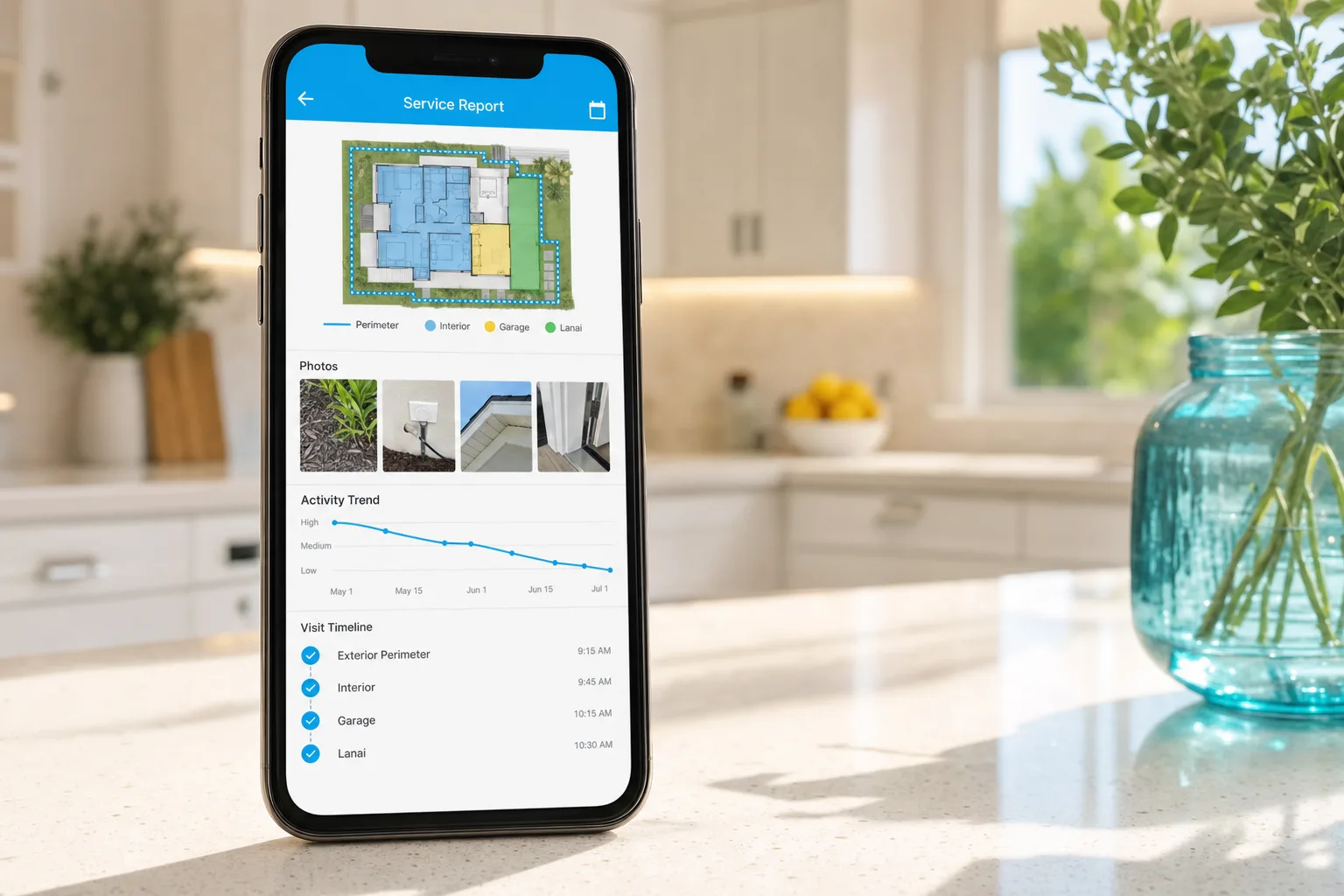
Inside your report you’ll find:
- A visit timeline — your tech en route, on the property, and completion, timestamped.
- A property treatment map — a color-coded map of your home showing the treated zones, perimeter lines, entry points, and web/nest sweep spots, so you can see exactly where the work happened.
- Field photos of what was found and treated — evidence, not claims.
- Findings and recommendations — anything notable the tech logged, with severity and next steps.
- Your Pest Pressure Index — our proprietary 0–5 score for your property, trended against your previous visits so you can actually see pressure trending down over the course of the year.
For the full step-by-step of how a single visit unfolds on the day, see what to expect during a Waves pest control visit.
Where every report lives: your customer portal
One visit gives you one report. A quarterly program gives you a documented history. Every visit lives in your Waves customer portal — filter by year, search by service, and open any report as a PDF whenever you need it. Each one keeps the date, your technician, the products used (down to the active ingredient and how it works), the field photos, and the findings. So a year into service you’re not relying on memory — your whole protection record is organized, timestamped, and a login away.
Is quarterly pest control worth it? Quarterly program vs. one-time spray
A one-time spray feels good for a few weeks. The problem is Florida pressure doesn’t take the rest of the year off — so a single treatment lapses, and you’re back to reacting. Here’s the honest trade-off.
| What you get | One-time spray | Quarterly Waves program |
|---|---|---|
| Named, fixed protocol every visit | One-off, varies | Yes — Exterior General Pest Perimeter, locked |
| Repellent + non-repellent (transfer effect) | Usually repellent only | Both modes, by design |
| Lanai / screen cage / front-door sweep | Often skipped | Required step every visit |
| Barrier maintained between visits | No — lapses in weeks | Yes — renewed every 3 months |
| Live GPS tracking + same-day report | No | Yes, every visit |
| Pest Pressure Index trend over time | No | Yes — scored and tracked |
| Re-service if pests return | Pay again | Free — the Waves Guarantee |
Pricing depends on your home size, lot, and conditions — build your property-specific estimate at /pest-control-calculator/.
For most Lakewood Ranch homes, quarterly is worth it precisely because it’s a program: the barrier never fully lapses, the trend is tracked, and you’re covered in between.
You don’t have to take our word for it — watch the line
Here’s the part that turns “trust us” into proof. Every visit scores your home on the Pest Pressure Index (0–5), and your portal charts those scores over time with the change since your last visit. It takes a couple of visits to draw the line — but once it’s there, you can watch it. The pattern many quarterly homes see: pressure eases over the first visits, then tends to creep back up right around the 90-day mark — which is exactly when the next quarterly visit lands to push it back down. You’re not guessing whether the program is working; you’re reading the trend.
How you get your quote: request to first visit
You don’t have to sit through a sales pitch to find out what quarterly service costs at your address. Here’s the whole path:
- Request a quote — tell us about your home, or start with the estimate tool.
- We build a property-specific price — for the exact Exterior General Pest Perimeter protocol above, based on your home’s size, lot, and conditions plus your starting Pest Pressure Index. Not a generic “starting at.”
- Review it on your own time — your estimate arrives as a link you can open and read line by line. No pressure, no salesperson at the door.
- Approve in one tap — accept the estimate right from the link.
- Reserve your first visit — pick from the soonest available windows and you’re on the schedule.
No surprise add-ons and no long-term contract to sign — just a clear price for a clearly-defined service.
Pricing and protection levels
We don’t quote flat rates off a script. Your estimate is property-specific — built from your home’s size, lot, and conditions, plus your Pest Pressure Index, so the price reflects the real risk at your address. Protection comes in tiers — WaveGuard Bronze through Platinum — so you can match coverage and savings to your home. Recurring WaveGuard membership also carries a 90-day money-back guarantee, and one-time services can include a 30-day callback period.
Want the actual number for your home? Build your estimate online — no callback tag, no negotiating — or call ☎️ (941) 297-5749.
How you’re billed — and how easily you can pause
Staying on schedule is automatic; how you pay stays in your control. Turn on autopay — handled securely by Stripe, with your card kept on file only after you say so — and you’re charged on the billing day you pick. Heading north for the summer? Pause your billing right from your portal and pick it back up when you’re home. Want the 25th instead of the 5th? Change your billing day yourself. There’s no long-term contract and no cancellation fee — the autopay convenience is opt-in, never a trap.
The Waves Guarantee
If pests show up between your scheduled quarterly visits, that’s the Waves Guarantee: we come back and re-treat at no extra charge. That’s the entire point of a program — you’re protected between appointments, not just on service day. See a few more ants than usual a couple weeks after a visit? Call us and we’ll knock it down.
Complete your home’s protection in Lakewood Ranch
Quarterly pest control covers the general-pest pressure most homes deal with year-round — but Florida throws more than ants and roaches at your house. Because your technician is at your property every quarter, they often spot the early signs of problems that need their own specialized treatment and flag them in your report. If you’d rather one team handle the whole envelope, Waves also covers:
- Termite control in Lakewood Ranch — the one pest that does real structural damage, and the one worth its own dedicated plan.
- Mosquito control in Lakewood Ranch — knock down the biting pressure that makes the lanai unusable at dusk.
- Tree & shrub care in Lakewood Ranch — protect the landscaping that doubles as pest harborage right up against the house.
- Lawn care in Lakewood Ranch — a healthy, treated lawn is a far less hospitable runway for pests heading toward your foundation.
Bundle recurring services and your WaveGuard tier — and your savings — climb together.
Ready to get started in Lakewood Ranch?
Quarterly pest control should be a known quantity, not a mystery. With Waves you get a named, documented protocol four times a year, two modes of action working together, the lanai-and-front-door sweep included, live GPS tracking, and a same-day report you can actually read — all from a team that lives and works in Southwest Florida. We proudly serve Manatee, Sarasota, and Charlotte counties.
The Waves promise: property-specific estimates · named, FDACS-licensed techs · no long-term contracts · a documented report after every visit · free re-service between visits (the Waves Guarantee).
Already with us and happy? Your portal gives you a personal referral link — neighbors you send our way get a welcome discount, you earn account credit, and milestone rewards stack up as your referrals grow. In a neighborhood like Lakewood Ranch, where pest pressure doesn’t stop at the property line, a protected block is a quieter block.
👉 Get your property-specific estimate or call ☎️ (941) 297-5749 to start quarterly service.
Frequently Asked Questions
What does quarterly pest control actually include? Every quarterly visit runs our Exterior General Pest Perimeter protocol: a full sweep-down of pest pheromone trails, then both repellent and non-repellent treatment applied across the foundation, entry points, and cracks and crevices, plus applications to landscape beds and shrubs. It also includes a required web and nest sweep-down of the eaves, windows, doors, and the lanai and screen cage and front-door area. Everything is documented in a same-day post-service report.
Do I need to be home for a quarterly visit? Not for a standard exterior visit — as long as we can reach the gates, lanai, and garage, and pets are secured. The core protocol is exterior. If you want targeted interior treatment that quarter, you’ll want someone home to let the tech in. Either way you’ll watch the tech arrive on live GPS tracking and get your full report afterward.
Does the visit include sweeping the lanai, screen cage, and front door for webs? Yes. The Webster sweep — knocking down webs and nests from the eaves, windows, doors, and explicitly the lanai and screen-cage frames and front-door area — is a required step of every quarterly visit, not an add-on.
Is quarterly pest control safe for my kids and pets? Yes, when handled correctly. Every product is applied strictly to its EPA label by a technician licensed under FDACS License JB351547, and your tech gives you simple re-entry guidance for any treated areas and a pet note where relevant.
Why two different kinds of product — repellent and non-repellent? Because they do different jobs. The repellent forms a perimeter barrier pests avoid crossing, while the non-repellent products are undetectable to pests, so they walk through, pick up the active ingredient, and carry it back along their trails to the colony. Pairing both modes treats the source, not just the scouts you can see.
Is quarterly pest control worth it compared to a one-time spray? For most Lakewood Ranch homes, yes. Florida pressure doesn’t take a winter break, so a one-time spray lapses within weeks. A quarterly program renews the barrier every three months, tracks your Pest Pressure Index over time, and includes free re-service between visits. See the full side-by-side in what to expect during a Waves pest control visit.
How do I get started? Build your estimate online or call (941) 297-5749. We’ll capture your property details, score your Pest Pressure Index, and send a transparent, itemized quote you can approve in one tap.
Does quarterly pest control actually work — and how would I know? You can see it, not just feel it. Every visit scores your home on the Pest Pressure Index (0–5), and your portal charts the trend over time. After the first couple of visits you’ll have a line to watch: most quarterly homes see pressure ease and then get pushed back down each visit before it can rebuild. It’s reduced, monitored pressure you can actually track — not a vague promise.
Am I locked into a contract, and how am I billed? No long-term contract and no cancellation fee. You can turn on autopay (handled securely by Stripe), choose your own billing day, and pause it from your portal anytime — for travel or any reason. Pricing is property-specific, so build your estimate or call (941) 297-5749 for your number.